5 June 2026 · Maison Zola
Five mistakes people make when photographing their dog for a portrait
A working painter's list of the five most common source-photograph mistakes that show up in finished pet portraits, and how to avoid each one.
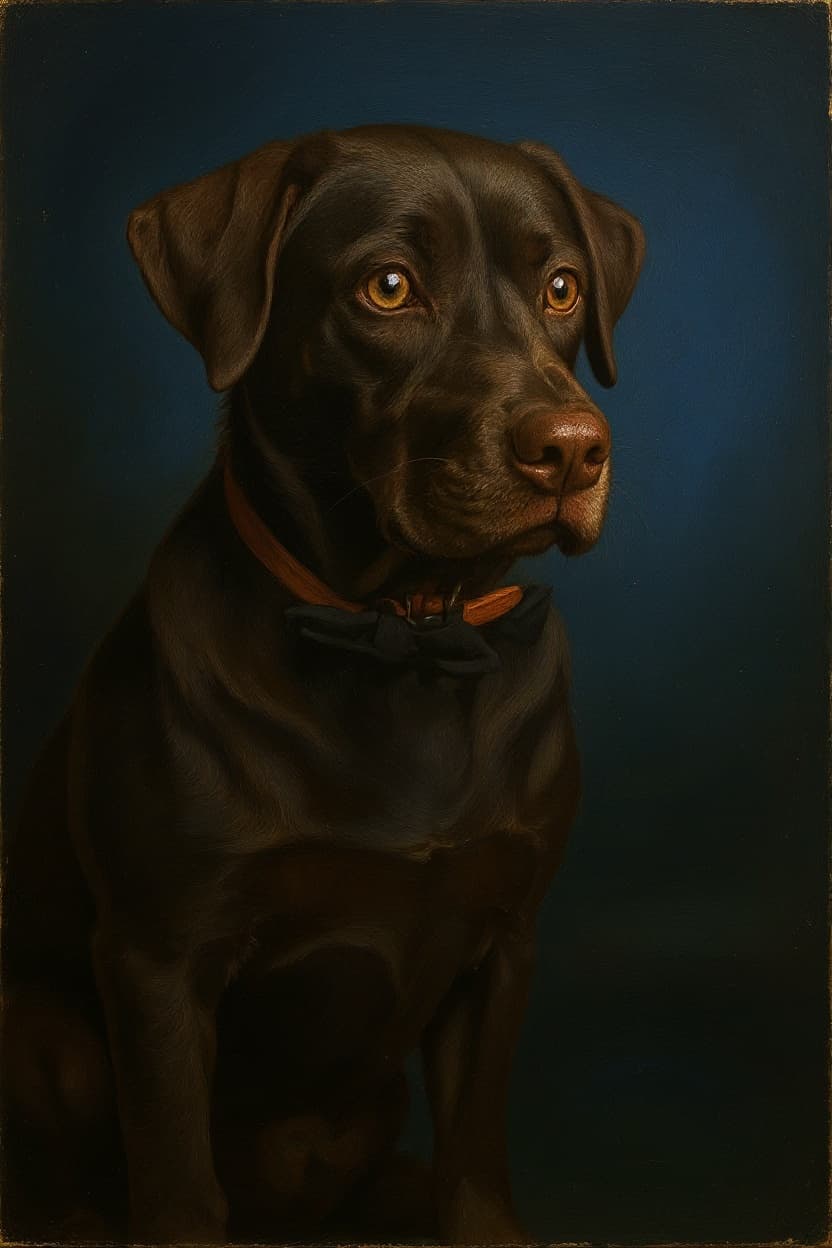
The single biggest factor in how a custom pet portrait turns out is not which company you commission it from. It is the source photograph. After a few hundred commissions across our three studio styles, we see the same five mistakes show up repeatedly in source photographs, and the same five corresponding problems show up in the finished portraits. This is the list.
The advice applies regardless of which studio or artist you commission. We work in oil; Crown & Paw works in Renaissance regalia; Letterfest works in watercolour. None of us can fully fix a difficult source photograph. All of us produce better work from a good one.
1. The photograph was taken from above
This is the most common mistake. The photographer (you, the owner) was standing up. The dog was on the floor or on a sofa. The phone or camera was pointed downward at the dog from your eye level.
What this does to the finished portrait: the dog's face foreshortens. The forehead becomes the largest visible plane. The eyes recede. The body, viewed from above, becomes a roughly oval shape rather than a distinct body. The proportions read as wrong even when every element is technically correct.
What to do instead: photograph the dog from approximately the dog's own eye level. For a Labrador or a German Shepherd, this means roughly your knees. For a Dachshund or a Pomeranian, this means lying on the floor with the phone close to the ground. The angle changes everything. We can sometimes correct a moderately top-down photograph in oil, but past a certain angle the painting starts to look like a different dog.
2. The lighting is wrong
Two specific lighting mistakes account for most of the problem photographs we receive.
Hard direct sunlight outdoors. Customers love to photograph their dogs at the park in the middle of the day. The result is hard shadows under the brow that hide the eyes, blown-out highlights on the top of the head, and an overall flatness in the body where the light is bouncing too uniformly.
Phone front-camera flash indoors. The flash is too close to the lens, hits the dog from approximately the lens angle, and produces the same flatness as overhead sun plus the red-eye effect. We cannot paint around a flash-lit photograph; the underlying structural information is not there.
What to do instead: photograph the dog indoors near a large window in the late morning or mid-afternoon. The window is the painter's preferred light source: soft, directional, and a single source. Hold the phone or camera with the window to one side of the dog, not behind you (which would put the dog in your shadow) and not behind the dog (which would produce a silhouette). Forty-five degrees off the front of the dog is the sweet spot.
3. The dog is not actually looking at the camera
The painter needs to see the dog's eyes to paint the face. This sounds obvious. It is not how most pet photographs are taken.
Customers send us photographs where the dog is mid-walk, distracted by something off-frame, looking at another dog, or looking past the camera at the owner who is calling them. The resulting expression in the finished painting carries that distraction. The dog reads as preoccupied rather than present.
What to do instead: have a second person help. One person operates the camera; the other person stands directly behind the camera and gets the dog's attention with a toy, a treat, or just a sound the dog finds interesting. The dog should be looking at the second person, which means looking through the lens. This is how every reasonable portrait of a person also gets taken; pets are no different.
Five seconds of attention is enough. You only need one frame.
4. The photograph shows the dog mid-pant or mid-yawn
This is a subtype of "wrong moment captured." Customers often try to photograph their dogs when the dog is in some state of activity, which means the mouth is usually open and the tongue is showing. The dog looks happy in the photograph. Painted into oil, the open mouth reads as either a pant (suggesting heat or exhaustion) or a yawn (suggesting boredom) or, in the worst case, an aggressive bark.
A closed mouth, or a slightly parted mouth with the lower lip relaxed, is the resting expression of nearly every dog. This is the expression you want in the painting.
What to do instead: wait for the dog to settle. After a walk or a play session, when the dog has come back inside and is in a calm state, take the photograph then. The closed-mouth or slightly-open-mouth pose is the dog's actual baseline expression and it is what you want hanging on a wall for the next forty years.
5. The photograph is a composite or a phone screenshot
This is the mistake of source quality. Customers sometimes send us a screenshot of a video frame, a photograph re-photographed from another phone screen, an image cropped from a group photograph, or a composite of multiple images stitched together. The painter cannot recover the resolution and colour information that was lost in those operations.
The signs of a low-quality source: visible pixelation, compression artifacts (small blocky squares in solid-colour areas), washed-out colours, or fine detail that looks smudged. A painter working from a smudged source produces a smudged painting.
What to do instead: send the original photograph file, taken directly with a camera or phone. Higher resolution is better; a 1024×1024 image is workable, a 4000×4000 image is comfortable. If the photograph was taken on a phone, the photograph in the phone's gallery is the original; the version you texted to yourself or downloaded from Instagram is a re-encoded copy with lost information. Use the original.
What good photograph looks like
To make the list constructive: a usable source photograph for a custom dog portrait has all of the following.
- Taken from the dog's own eye level
- Lit by a window or by soft daylight, the light coming from one side of the dog rather than from behind the photographer
- The dog looking at the camera (or just past it), with both eyes clearly visible
- The mouth closed or slightly parted, not panting or yawning
- The original file, not a screenshot or composite
If the photograph you have meets all five criteria, the painter has everything they need. If it does not, retake it. Five minutes of better photography saves a month of revisions later.
This is the single highest-leverage thing anyone commissioning a pet portrait can do. The studio matters; the painter's skill matters; the chosen style matters. But none of those compensate for a source photograph that does not give the painter what they need to start.
Sources
- Internal studio notes on common source-photograph problems, drawn from 18 months of customer commissions
- Companion reviews on the same theme: Crown & Paw review, West & Willow review, Letterfest review