8 June 2026 · Maison Zola
A short history of the Renaissance pet portrait
From Veronese's lapdogs to Velázquez's mastiff in Las Meninas, trace how the animal became a presence in European portraiture and what that lineage means today.
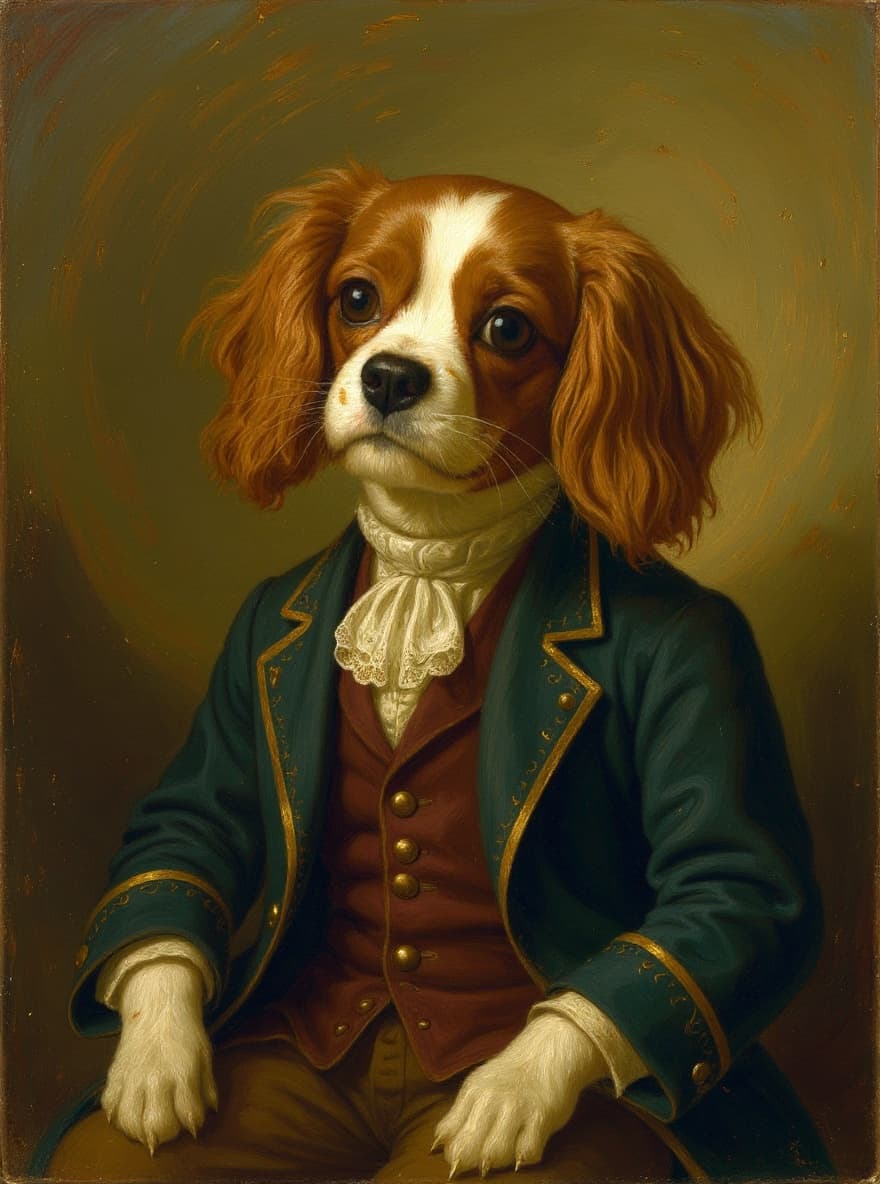
The dog at the edge of the frame
In Paolo Veronese's Wedding at Cana, painted in 1563 for the refectory of San Giorgio Maggiore in Venice, a small white dog sits at the very front edge of the composition. It is not incidental. Veronese placed it there with the same deliberation he applied to every figure in that enormous canvas: the dog is a sign of domestic order, of the household well kept, of abundance made visible. It looks out at the viewer rather than at the feast. That outward gaze is the beginning of something.
Over the following century and a half, the animal in European portraiture shifted position. It moved from the edge of the frame toward the center. From symbol toward subject. The history of the Renaissance pet portrait is, in part, the history of that migration.
Heraldic emblem to companion: the sixteenth century
The early tradition was largely heraldic. Dogs in fifteenth and sixteenth century portraiture carried meaning before they carried personality. The greyhound at the feet of a nobleman signified loyalty and noble lineage. The small spaniel in a lady's lap signified fidelity, sometimes chastity. Hans Holbein the Younger understood this vocabulary fluently: in his portrait of Henry VIII, the king's physical mass alone communicates dominance, but in smaller court portraits of the period, the lap dog functions as an attribute, the way a sword or a book might.
Titian worked the same grammar but began to loosen it. His Portrait of Clarissa Strozzi from 1542 shows a two-year-old child with a small dog on a ledge beside her. The dog is not purely symbolic here. It responds to the child, turns toward her hand. There is a relationship being depicted, not just a status marker being deployed. That distinction matters: the moment the animal turns toward its owner rather than facing outward, it becomes a presence rather than an emblem.
Velázquez and the mastiff in the room
No painting in the European tradition makes the case more forcefully than Las Meninas, completed by Diego Velázquez in 1656. The large mastiff lying in the foreground right of the composition is not performing any symbolic function. It is simply there, the way a large dog is simply there in a room it knows well. A child prods it with one foot; the dog does not stir. The whole painting is organized around the question of who is looking at whom, and the dog, alone among all the figures, is indifferent to that question. Its presence is purely physical, purely companionate.
Velázquez had painted dogs before Las Meninas, most memorably in the hunting portraits of Philip IV, where hounds appear as instruments of the chase. But the mastiff in the Meninas is something different. It has no function in the composition except to be itself. That is a radical thing for a seventeenth century court painter to do, and it was noticed.
The Flemish cabinet picture and Frans Snyders
While Velázquez was working in Madrid, a different tradition was developing in the Spanish Netherlands. The Flemish painters of the early seventeenth century had inherited from their Netherlandish predecessors a passion for the particular, for the specific texture of a fur coat, the exact color of a hound's eye, the way light falls on a short-haired coat differently than on a long one.
Frans Snyders, who worked in Antwerp and collaborated closely with Rubens, built an entire career on animals rendered with that specificity. His hunting scenes and market pieces are full of dogs painted with a close attention to breed character that anticipates the nineteenth century sporting tradition by two hundred years. Snyders understood that a greyhound and a mastiff are not interchangeable, that the taper of a greyhound's skull and the breadth of a mastiff's jaw require entirely different brushwork. He painted them accordingly.
Paul de Vos, Snyders's brother-in-law and frequent collaborator, extended the same vocabulary into pure animal compositions, pictures in which the dog or the cat is not attending on a human subject but is itself the entire subject. These cabinet pictures were collected by the Flemish merchant class as demonstrations of the painter's virtuosity and as objects of genuine affection for the animals depicted. The companion animal, in the Flemish tradition, was worth painting on its own terms.
Van Dyck and the portrait with a dog
Anthony van Dyck, who trained under Rubens and eventually became court painter to Charles I of England, refined the relationship between human subject and canine companion into one of the great formal achievements of seventeenth century portraiture. In his Children of Charles I, painted in 1637, a large mastiff sits beside the three royal children with a gravity that matches theirs. The dog is not subordinate to the composition. It anchors the left side of the canvas with the same weight that the eldest child anchors the right.
Van Dyck understood something that later portrait painters sometimes forgot: the dog in a portrait is not a prop. It has its own axis, its own relationship to the light, its own claim on the viewer's attention. When he painted the Cavalier King Charles Spaniel, the small silky spaniel that would eventually take the king's name, he rendered it with the same three-quarter gravity he applied to human sitters. The breed's wide-set eyes and domed skull reward that treatment. They photograph as sentiment; they paint as character.
The formal vocabulary that emerged
By the middle of the seventeenth century, a formal vocabulary had settled into place. The companion animal portrait, whether the animal appeared beside a human subject or alone, operated according to a set of understood conventions.
The ground was dark, usually a warm near-black that pushed the subject forward and concentrated the light on the face. The pose was three-quarter, the body turned slightly from the viewer while the eyes held the viewer's gaze. The lighting was single-source, raking across the subject from one side to model the form. Costume and setting were subordinate to the face, which carried the expressive weight of the whole picture.
These were not arbitrary choices. They were the result of generations of painters working out how to make a two-dimensional surface read as a presence. The dark ground works because it eliminates spatial ambiguity and forces the eye to the subject. The three-quarter pose works because it implies a body that exists beyond the frame. The raking light works because it gives the face topography, and topography gives the face life.
From the seventeenth century to the atelier
The lineage from Snyders and Van Dyck to the modern Renaissance pet portrait commission is not a metaphor. It is a direct technical inheritance. The alla prima brushwork, the warm ground preparation, the close-value modeling of the face in passages of umber and lead white: these are period techniques, and they are the techniques the atelier uses.
Our studio sits in Mont de l'Enclus, in the Belgian province that lies between Ghent and Tournai. The Flemish tradition was not formed elsewhere and imported here. It formed in this landscape, in the light that comes through north-facing windows in the low countries, flat and even and without the hard shadows of a Mediterranean sun. When we prepare a dark ground and place a dog's face against it, we are working in the same light the seventeenth century painters worked in.
What the Renaissance painters understood, and what the atelier tries to honor in every custom pet portrait, is that the companion animal has always been worth the full gravity of the portrait tradition. The dog in Las Meninas is not a footnote to Velázquez's achievement. It is part of the argument the painting makes about presence, about what it means to be in a room with another creature who is simply, unmistakably, there.
The animal at the center of your life deserves the same attention. That is the only proposition the Renaissance portrait makes.