11 May 2026 · Maison Zola
Choosing a pet portrait style: a brief guide
Three studio styles, one subject. A practical guide to matching your pet's character and your interior to the right portrait tradition from our Belgian atelier.
The question before the canvas
Before a single brushstroke is laid, there is a decision that shapes everything: which tradition should carry the portrait. A dog painted in the manner of a seventeenth century Flemish court sits in a different conversation than one rendered in the warm, unmediated language of direct oil observation. Neither is more correct. They answer different questions about the subject and about the room the painting will enter.
Our atelier works in three studio styles. Each draws from a distinct period of European portraiture. Each suits a different kind of animal, a different kind of interior, and a different relationship between the owner and the image they want to keep.
The oil painting: the most direct register
The oil painting portrait is the least costumed of the three. The subject is painted as itself, in the full warmth of the oil medium, without the formal apparatus of court dress or ceremonial regalia. What the style offers is intimacy and material presence: the coat rendered in long, close-value passages, the eyes given the full weight of the painter's attention.
This is the tradition that runs from the seventeenth century animal studies of Jan Fyt and Frans Snyders through to the Victorian sporting paintings of Sir Edwin Landseer. In each case the animal is treated as a serious subject, not an accessory. The breed's actual character is the content of the picture.
The oil portrait suits animals whose physical presence is already striking without embellishment. A Maine Coon's mane and tufted ears, a Golden Retriever's coat catching studio light in long warm planes, a Border Collie's focused gaze held against a dark ground. These are subjects that reward close, unhurried looking. The style also suits interiors that already carry some weight: a library, a hallway with period furniture, a sitting room where the walls are not competing with the canvas.
If there is a guiding principle for this style, it is restraint. The painter's job is to render the animal with the same gravity a seventeenth century portraitist would have brought to a human sitter. The coat is painted, not illustrated. The face is the priority.
The Renaissance portrait: court gravity applied to the household
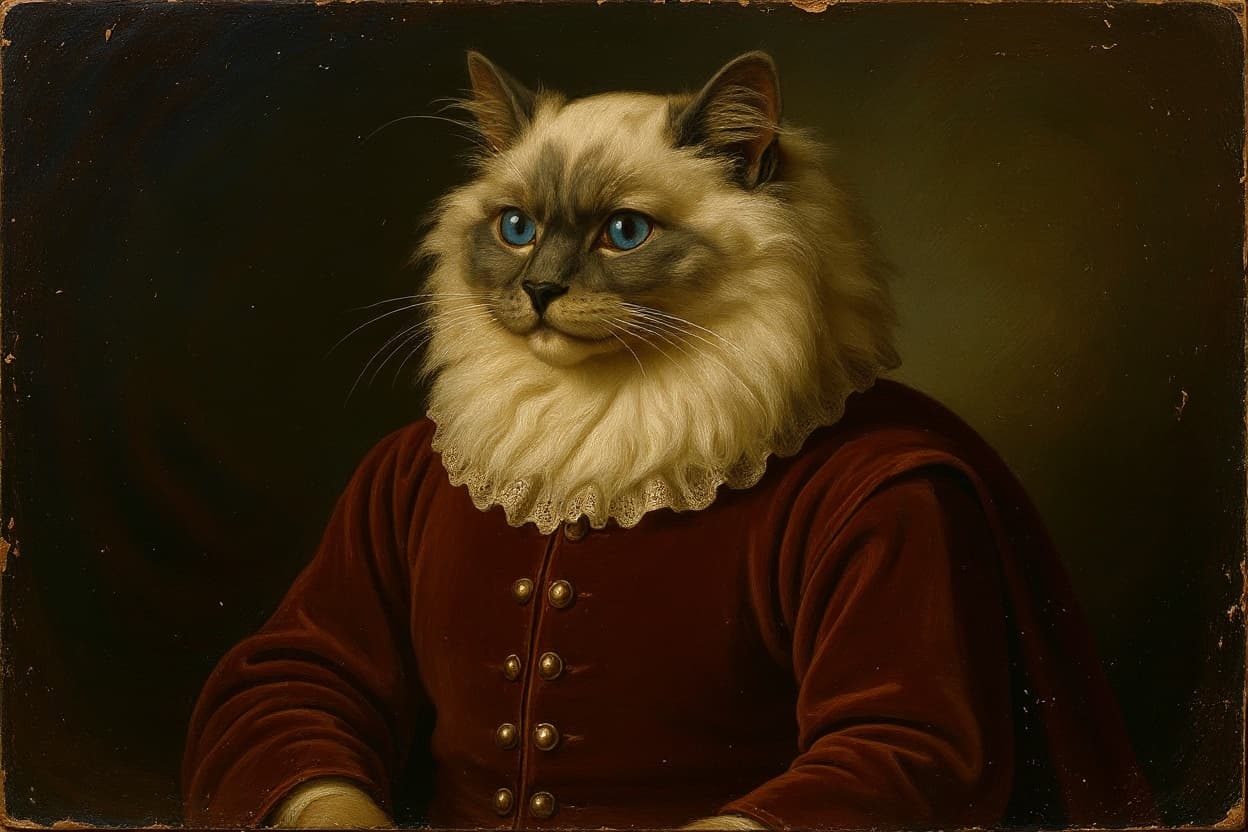
The Renaissance portrait places the subject inside the visual vocabulary of sixteenth and seventeenth century European court portraiture. Deep velvet doublet in burgundy or umber, ruffled white lace at the throat, the dark studio ground that throws the subject forward into the light. The composition follows the period's conventions: three-quarter angle, the subject occupying the painting's center of gravity, the brushwork moving in passages of warm tone rather than discrete marks.
The tradition this style draws from is not a vague evocation of antiquity. It is the specific lineage of Flemish portraiture, from Rubens and Van Dyck through the great studio painters of the Spanish Netherlands. Our atelier sits in Mont de l'Enclus, Belgium, and we paint into that lineage directly. The costume is period-accurate in its vocabulary, even when the subject has four legs and a tail.
What the Renaissance portrait does is confer a particular kind of dignity. The animal is not dressed for comedy. It is dressed as a member of the household would have been dressed for a formal sitting, because in the logic of the seventeenth century portrait, that is precisely what it is. The breed's actual features are painted with care; the costume is the frame, not the subject.
This style suits animals with a naturally composed bearing. A French Bulldog's wide-set eyes and upright ears read as both patrician and attentive in the period setting. A Maine Coon, painted against a dark ground with the mane catching the light, becomes something close to a Flemish cabinet painting of a small wild animal. The Renaissance portrait also suits rooms with a period character: panelled walls, dark wood, a colour palette that runs to ochre and deep green.
For those who want the full weight of the court tradition without the theatrical register of ceremonial dress, this is the style that delivers it most directly.
The royal portrait: the theatrical commission
The royal portrait is the most formally ambitious of the three. The subject wears the full ceremonial regalia of a coronation portrait: heavy gold crown set with red gemstones, ermine-trimmed velvet cape draped across the shoulders, deep burgundy backdrop with the soft suggestion of a gold-framed throne behind. The composition is high-contrast, the lighting formal, the visual vocabulary drawn from the great state portraits of the eighteenth and early nineteenth centuries.
This is not a style that pretends to understatement. It is a deliberate deployment of the most loaded imagery in the European portrait tradition, applied to the animal at the center of a household. The effect depends on a particular kind of knowing gravity: the costume is theatrical, but the face is painted with restraint. The joke, if there is one, is the dignity, not a caricature of it.
The royal portrait suits animals with a strong physical presence and a face that can carry the weight of the regalia without being overwhelmed by it. A Golden Retriever's open, warm expression holds its own against an ermine cape. A French Bulldog's heavy brow and direct gaze give the composition the slightly imperious quality the style requires. The portrait also suits rooms that are already willing to make a statement: a bold wallpaper, a formal dining room, a hallway that can take a large-format canvas.
The scale of the royal portrait tends to run larger than the other two styles, because the composition needs room to breathe. A small canvas compresses the regalia into something fussy. Given space, the image settles into the room with a quiet authority that is, in the end, the point.
How to choose between them
The honest answer is that the choice is partly about the animal and partly about the room, but mostly about the relationship between the two.
If the goal is a portrait that will read as a serious work of art first and a pet portrait second, the oil painting is the right choice. It asks the most of the subject and returns the most in terms of material presence and longevity of feeling. It is the style that will still be worth looking at in fifty years, because it is not dependent on the period costume for its effect.
If the goal is to place the animal inside a specific historical tradition, to give it the gravity of a sitter who mattered to the household in the way that a seventeenth century court dog mattered to its patron, the Renaissance portrait is the more precise instrument. It is formal without being theatrical.
If the goal is a portrait that announces itself, that makes the room pause, that carries the full weight of European state portraiture while remaining entirely clear-eyed about what it is doing, the royal portrait is the commission to place.
All three styles are rendered from one of your own photographs and finished on archival materials in our Belgian atelier. The process for each is the same: a careful reading of the photograph, a considered choice of composition, and the slow accumulation of the oil medium over the ground. What differs is the tradition the painter is working inside.
A note on breed and style
Some breeds have a natural affinity with particular styles, and it is worth naming them plainly.
The Border Collie, with its black-and-white coat and its characteristic held stare, suits the oil painting most naturally. The breed's power is in its focus, and the oil portrait renders that focus without distraction.
The Maine Coon, painted against a dark ground in the Flemish manner, becomes something genuinely striking in either the oil or the Renaissance style. The mane and tufted ears reward the close brushwork both traditions require.
The French Bulldog, whose face reads as both clown and patrician, holds its own in all three styles, but the Renaissance portrait gives it a particular kind of dignity that suits the breed's natural composure.
The Golden Retriever's coat, which catches studio light the way an oiled oak panel does, in long warm planes, is at its best in the oil portrait. The royal portrait works for the breed too, but the oil is where the warmth of the coat is most fully rendered.
These are tendencies, not rules. The right choice for a custom pet portrait depends on the specific animal, the specific photograph, and the specific room. What we can say is that each of the three styles has been developed to do something the others cannot, and that the choice between them is worth making carefully.