2 June 2026 · Maison Zola
Dog breeds most suited to renaissance portraits
A working painter's list of which dog breeds carry the seventeenth-century Flemish portrait register best, and why. From the Cavalier King Charles to the Mastiff.
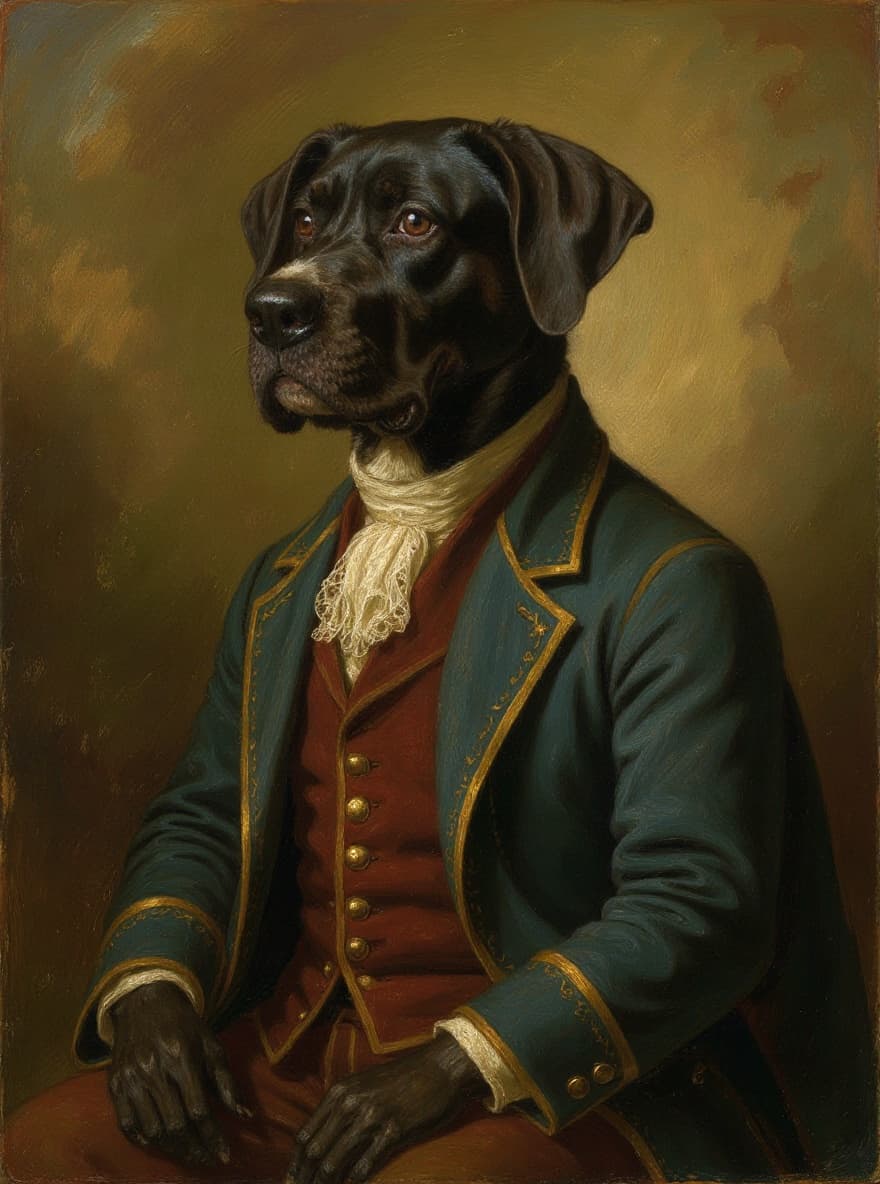
Not every dog suits every style. A breed that paints beautifully in the classical-oil register might land awkwardly in the Renaissance vocabulary, and vice versa. After a few hundred commissions across all three of our studio styles, this is the working painter's list of which dogs carry the Renaissance portrait register the most naturally. The list is not exhaustive. Many other breeds also work in this style. These are the ones that work without the painter having to argue the case.
A quick note on what we mean by "the Renaissance register." We mean the seventeenth-century Flemish and English tradition. Dark backgrounds. Warm chiaroscuro. The subject drawn out of the canvas by a single directional studio light. Soft modelling of the face, attention to the silken passages of fur, restrained colour palette. The painters of reference are Van Dyck, Sir Peter Lely, the lesser circle around Anthony van Dyck. The dogs in their paintings sat in the laps of women in oil portraits, and we paint dogs today in the same vocabulary.
These are the seven breeds we recommend the Renaissance treatment for, most enthusiastically.
1. Cavalier King Charles Spaniel
This is the obvious one, and the reason is in the name. The breed is named for Charles II of England, restored to the throne in 1660, who kept these small spaniels in such constant company that his court painters (Sir Peter Lely chief among them) painted the dogs as participants in almost every formal occasion of the period. The breed has been a subject of Renaissance and Baroque portrait painting for three and a half centuries.
The proportions, the long silken ears, the soft brown eye, the four coat colours (Blenheim, tricolour, ruby, black-and-tan) all sit naturally in the seventeenth-century palette. We paint the Cavalier King Charles Spaniel in the Renaissance register more often than in either of our other two styles, and we recommend it for almost every Cavalier commission.
2. King Charles Spaniel
The Cavalier's slightly different cousin. The King Charles Spaniel (without "Cavalier") has a flatter face and a heavier brow, the result of late-nineteenth-century breeding choices that diverged from the original Stuart-era type. Despite the structural difference, the breed sits in the same Renaissance vocabulary as the Cavalier and for the same reasons: it has been there for centuries.
If anything the King Charles is slightly easier to paint in the Renaissance style than the Cavalier, because the heavier brow gives the face additional structural weight that the period vocabulary handles well.
3. Mastiff
The Mastiff is a different kind of Renaissance subject. Not the lap dog of a Stuart court but the guard dog of a country estate. The breed appears in English country-house painting from the seventeenth and eighteenth centuries, usually at the feet of a male sitter, sometimes alone in a barn or kennel setting. The painter's treatment is different from the small spaniels: more directional light, more attention to the bone structure of the head, less concern with silken-coat passages.
The Mastiff carries the Renaissance register through sheer presence. The breed has the weight that the seventeenth-century painters were looking for, and the heavy brow and dewlap respond well to warm chiaroscuro. We paint the Mastiff at a slightly lower light angle than the Cavalier, to find the underlying structure of the face.
4. English Bulldog
The Bulldog is a more recent painted subject than the Mastiff (English Bulldog as a recognised breed dates to the early nineteenth century, after the bull-baiting that gave the breed its name was outlawed in 1835). But the breed sits well in the Renaissance register for a reason that has more to do with the painter's task than with historical precedent. The heavy brow, the loose jowls, the deep-set eyes. These are the features the Renaissance vocabulary handles best, and the painter has the right tools to render them with dignity rather than caricature.
The Bulldog is one of the few breeds where we sometimes argue against the Renaissance treatment, but only for the brindle subjects, where the coat absorbs the dark Renaissance ground and the painting can read as too uniformly dark. White and pied Bulldogs sit in the style beautifully.
5. Italian Greyhound
The Italian Greyhound is a seventeenth-century lapdog with continental rather than English origins. The breed appears in Italian Renaissance painting, in the work of the Medici court painters, and somewhat later in the work of Velázquez (who painted small greyhound-type dogs in several Spanish royal portraits). The breed's slender proportions and elegant carriage are exactly what the Renaissance portrait sought.
The painter's challenge with the Italian Greyhound is the coat. It is short, smooth, and almost transparent in places. The Renaissance vocabulary handles this by relying on warm reflected light against a dark ground, finding the form of the body through subtle value shifts rather than coat texture.
6. Pekingese
The Pekingese arrived in the European visual record later than the other breeds on this list (the dogs were taken out of the Imperial Palace in Beijing in 1860 during the Opium Wars), but the Renaissance painting tradition has retroactively adopted the breed. The long flowing coat, the flat face, the imperious bearing. These read in seventeenth-century Flemish vocabulary as if the breed had always been there.
We paint the Pekingese in the Renaissance register with particular pleasure. The long coat allows for the kind of slow modelled brushwork that the period painters used for ermine and velvet, and the flat face takes the directional light in a way that emphasises the breed's character without flattening it.
7. Saluki
The Saluki is the oldest formally recognised dog breed in the world (depicted on Egyptian tomb walls from circa 2100 BCE) and it has been a subject of formal portrait painting since at least the medieval manuscript tradition. The Renaissance vocabulary handles the breed's lean, elongated structure with the same care the period painters gave to the courtly thoroughbred horse, a tradition the Saluki sits in more comfortably than in any of our other studio styles.
The painter's note: Salukis benefit from a slightly cooler colour temperature than the other breeds on this list. The breed's pale coats and the period vocabulary's warm palette can clash; we cool the ground slightly to let the subject sit forward.
Breeds we tend to recommend out of the Renaissance register
For completeness, the breeds we generally steer toward The Sovereign (royal regalia) or The Oil (classical contemporary) instead:
- Working dogs (Rottweiler, German Shepherd, Doberman): the breed's modern industrial-era origin and serious working bearing read better in The Oil's contemporary register.
- Modern American breeds (Labrador, Golden Retriever, Australian Shepherd): these breeds were not painted seriously until the late nineteenth or twentieth century, and the Renaissance register can read as a costume drama on them. The Oil suits them better.
- Toy breeds with elaborate grooming (Pomeranian, Bichon Frise, Maltese): The Sovereign's elaborate period costume can compete with the breed's natural ornament; The Oil handles them more cleanly.
Choosing for yourself
If you are commissioning a custom dog portrait and your dog is on the seven-breed list above, the Renaissance style is the recommendation. If your dog is on the second list, one of our other two styles will probably serve you better.
If your dog is on neither list, the answer is usually The Oil. The classical contemporary style is the most forgiving of the three and suits almost every breed. We recommend it when in doubt. The Sovereign and the Renaissance treatments are the more specialised choices for breeds whose particular history matches the register.
The painted portrait outlasts the room it hangs in by decades. Choosing the right register is the difference between a painting that ages into the wall and one that feels increasingly out of place. It is a choice worth thinking about.