20 May 2026 · Maison Zola
What an AI pet portrait generator can and cannot do
AI pet portrait generators are useful, fast, and free. Here is an honest account of what they produce, where they stop, and what comes after them.
The appeal is real
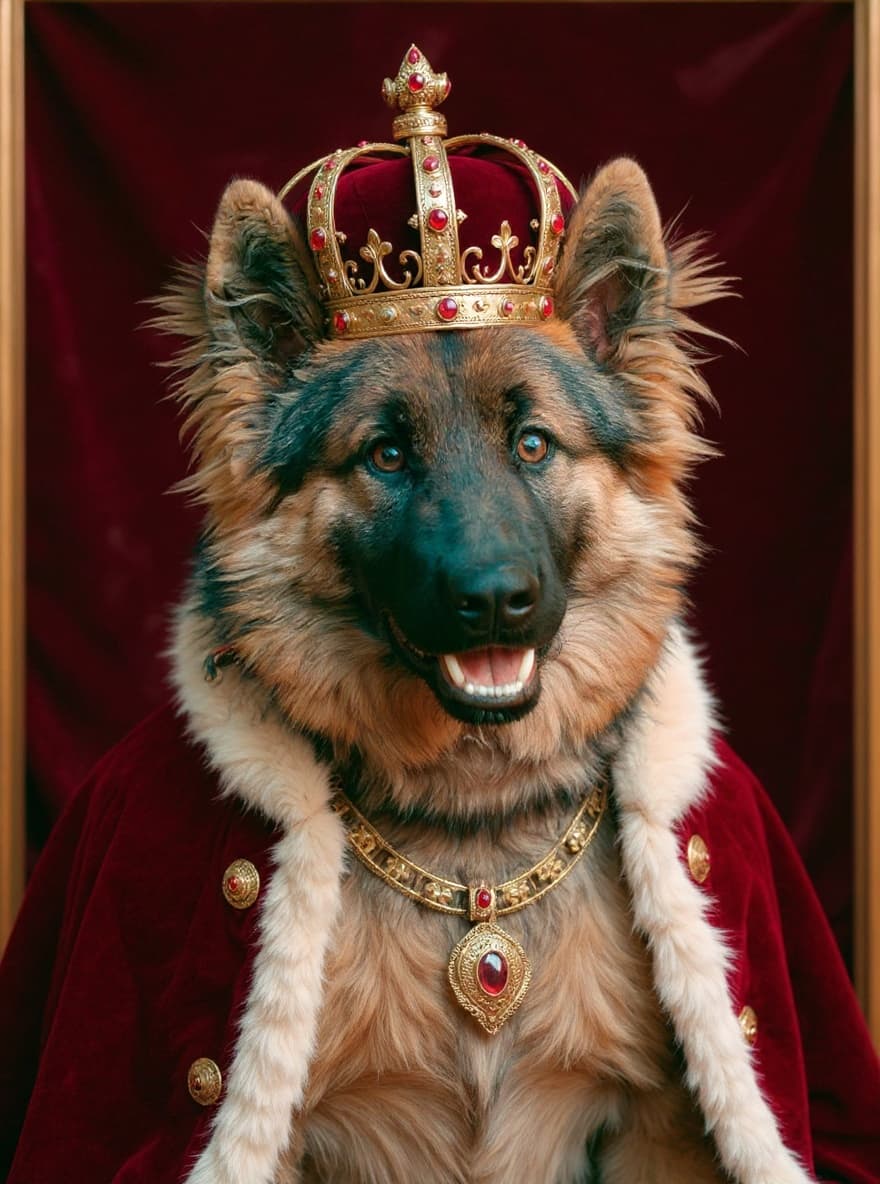
A photograph goes in. Seconds later, something that resembles a painted portrait comes out. The speed is genuinely remarkable, and for a certain kind of curiosity (what would my dog look like as a Renaissance subject?), the free tools answer the question quickly and without commitment.
We have no quarrel with that. The atelier exists in a different register, but it is worth being precise about where the registers differ, and why the distinction matters to the person who eventually wants something permanent on a wall.
What the generators actually do
Most AI pet portrait generators work by running a photograph through a diffusion model trained on large image datasets. The model has learned statistical patterns: what oil paint textures look like at a pixel level, what a ruff collar tends to look like in a seventeenth century portrait, how warm light falls across a fur coat in a studio setting.
The output is a plausible average of those patterns applied to the shapes in your photograph. When the photograph is clear and the subject is a common breed, the result can be striking at thumbnail scale. The likeness holds at a glance.
The limitation appears at closer range. The model has no understanding of your specific dog's face: the asymmetry in the ears, the particular set of the eyes, the way the coat lies differently on one shoulder. It produces a generalized version of the breed rather than a portrait of the individual animal.
Where the likeness breaks down
Portrait painters have a term for what the generators miss: character. Not personality in a sentimental sense, but the specific arrangement of features that makes one face distinct from every other face of the same type.
Sir Edwin Landseer spent decades painting individual dogs, not dog-shaped forms. His subjects are recognizable as themselves, not merely as representatives of their breeds. The seventeenth century Flemish masters brought the same precision to animal subjects that they brought to human sitters: particular eyes, particular coats, particular postures.
An AI model cannot do this because it has never looked at your dog. It has looked at millions of images and learned to recombine them. The result is competent, sometimes beautiful, but not a portrait in the historical sense of the word.
The question of materials
The generators produce image files. This is worth stating plainly, not as a criticism but as a fact about what the object is.
A JPEG rendered at screen resolution and printed on photographic paper is a different category of thing from a painting on archival canvas. The former is a reproduction of a generated image. The latter is a physical object made by a hand, with materials that will outlast the technology that produced them.
This is not nostalgia. The archival oil paintings we produce at the atelier are built on the same material logic that has kept seventeenth century Flemish portraits intact for four hundred years: ground canvas, pigment suspended in linseed oil, varnish over the surface. A file format will be obsolete long before the painting is.
What the free tools are genuinely good for
They are good for deciding. If you have never considered a painted portrait for a pet, running a photograph through a generator is a reasonable way to understand what the general category of thing looks like. You can see whether the Renaissance vocabulary suits your dog's face, or whether a more contemporary treatment would serve better.
They are good for sharing. The output is social-media-ready by design. It travels easily and generates the kind of response that a photograph does not.
They are good for the moment. A generated image of a dog who has since died is not a portrait, but it is something. It is a quickly made object that holds a shape.
We would not diminish any of those uses. They are real.
What changes when a painter looks at the photograph
When a commission comes into the atelier, the first thing we do is look at the reference photographs carefully. Not for breed type, but for the individual. The way the ears sit. The particular darkness around the eyes. The coat's actual color in natural light versus the warm cast the camera has introduced.
This looking is the work. It precedes the first mark on the canvas and it continues through the painting. The painter is making decisions that no model makes: this shadow is cooler than the reference suggests, this highlight needs to be lifted to read correctly in oil, the three-quarter angle from this photograph will serve the composition better than the frontal one.
The result is a painting of your specific animal, rendered in the visual language of a chosen period. Our oil painting portraits follow the same structural logic that Flemish portraitists used: a dark ground, warm light from one direction, the face as the center of gravity.
Breed and the question of dignity
One thing the generators handle inconsistently is breed character. A French Bulldog has a particular weight to the brow and a width to the skull that, handled carelessly, tips into caricature. A Border Collie's intensity lives in the gaze; a generative model tends to soften it because soft-eyed subjects appear more frequently in the training data.
We paint each breed with its actual character. The Golden Retriever's coat catches studio light in long warm planes; the painter's job is to keep that openness from sliding into sentimentality. The Maine Coon's mane and tufted ears reward careful brushwork; the eyes, set wide, do most of the expressive work. These are decisions a painter makes. They are not decisions a diffusion model makes.
The atelier's position in this
We are not the right choice for every purpose. If you want a quick image to share with family, a generator will serve you well and cost you nothing. If you want a preview of a painted style before committing to a commission, the generators are a reasonable first step.
What we offer is the step after that: a hand-painted, archival portrait of your specific animal, made in our atelier in Mont de l'Enclus, Belgium, from your own photographs. The process takes time. The result is a physical object.
The distinction is not between good and bad. It is between different categories of thing, made for different purposes, with different lifespans.
On permanence
The question that eventually arrives, for most people who care seriously about a pet, is not what looks good on a screen. It is what they want to keep.
A generated image is easy to make and easy to lose. It lives in a folder, or on a platform, or in a message thread. A painted portrait on archival canvas is harder to make and harder to lose. It occupies physical space. It can be handed on.
Our custom pet portrait process begins with the photographs you already have. The painting that results from them is made to last. That is the only promise we make, and we make it without qualification.