14 May 2026 · Maison Zola
Dog breeds that shaped the history of painted portraiture
From Egyptian greyhounds to the Cavalier spaniels of Van Dyck, these are the dog breeds that recur across five centuries of major painted traditions.
The oldest surviving painted dog is not a domestic pet. It is a lean, deep-chested hound rendered in profile on the wall of an Egyptian tomb at Beni Hassan, circa 1900 BCE. The posture is alert, the outline precise, the intent clearly portraiture rather than decoration. Five thousand years of painted dogs follow from that wall, and certain breeds appear again and again: not by accident, but because their physical forms answered something the painter needed.
The greyhound: the oldest continuous subject
No breed has a longer unbroken presence in painted tradition than the greyhound. The form is almost abstractly beautiful to a painter: the long tuck of the abdomen, the arched loin, the narrow skull tapering to a fine muzzle. It reads in silhouette the way a drawn line does.
In the Italian Renaissance, the greyhound appeared at the feet of rulers and condottieri. Pisanello placed one in his fresco cycle at the Palazzo Ducale in Mantua, circa 1440. Paolo Uccello returned to the breed repeatedly. By the time Veronese was painting his enormous banquet scenes in Venice, the greyhound had become a visual shorthand for aristocratic leisure, present in the foreground the way a coat of arms was present in the upper corner.
The English court tradition took the breed further. Van Dyck painted Charles I with a greyhound at his side in 1635, the dog's pale coat catching the same cool light as the king's silver armour. The pairing was not incidental: the greyhound signalled rank, restraint, and the long reach of the owner's lineage. Sir Edwin Landseer returned to the breed two centuries later, painting greyhounds with a naturalist's attention to muscle and coat that the seventeenth century had not attempted.
Our atelier continues to work with the greyhound for the same reasons the Renaissance painters did. The silhouette is architectural. The face, narrow and long, requires careful tonal modelling to avoid flatness. When it works, the result has the quality of a drawn line made permanent in oil.
The pug: the Baroque's most unlikely aristocrat
The pug arrived in Europe through Dutch trade with China in the sixteenth century and became, within two generations, one of the most painted breeds on the continent. The compressed face, the deep-set eyes, the wrinkled forehead: these are features that resist idealisation, and it is precisely that resistance that made the breed interesting to painters.
William Hogarth painted his own pug, Trump, in the 1730s. The portrait is a self-conscious act: Hogarth placed himself and his dog in the same composition, the dog's expression carrying the same watchful, slightly combative quality as the painter's own. The pug here is not a decorative accessory but a character, painted with the same psychological attention Hogarth brought to his human subjects.
On the continent, the breed was associated with the House of Orange and later with the court of Louis XV. Goya painted pugs in the Spanish court tradition, and Johann Georg de Hamilton produced careful Flemish-style studies of the breed for the Habsburg household. The pug's face, which could so easily become caricature, was treated by the best of these painters with complete seriousness.
That is still the challenge. When we paint the pug, we treat the heavy brow and the compressed muzzle as formal problems to be solved through value and edge, not as comic material. The breed's dignity is real; the painter's job is to find it.
The Cavalier King Charles spaniel: the Stuart dog
No breed is more thoroughly identified with a single royal house than the Cavalier King Charles spaniel with the Stuarts. Charles II kept spaniels of this type in his private apartments and was painted with them repeatedly. The association was strong enough that the breed took the king's name.
Van Dyck established the visual grammar. In his portraits of the children of Charles I, painted in the 1630s and 1640s, the spaniel appears at the edge of the composition or cradled in a child's arms: the long, silky ear falling against the child's sleeve, the round dark eye turned toward the viewer. The dog is painted with the same attention to texture as the satin and lace of the costume. Van Dyck's brushwork in these passages, the wet-on-wet technique he used to render the ear's soft fall, is among the finest animal painting of the seventeenth century.
Later painters returned to the breed for similar reasons. Sir Peter Lely, who succeeded Van Dyck as court painter, continued the tradition. By the eighteenth century the Cavalier had become a standard prop in the English conversation piece, appearing in works by Zoffany and Gainsborough as a marker of domestic ease and gentle rank.
The breed's face rewards the painter: the rounded skull, the wide-set eyes, the expression that reads as attentive without being anxious. We paint the Cavalier King Charles spaniel in the tradition Van Dyck established, with close attention to the ear's texture and the quality of light in the dark eye.
The poodle: the Versailles dog
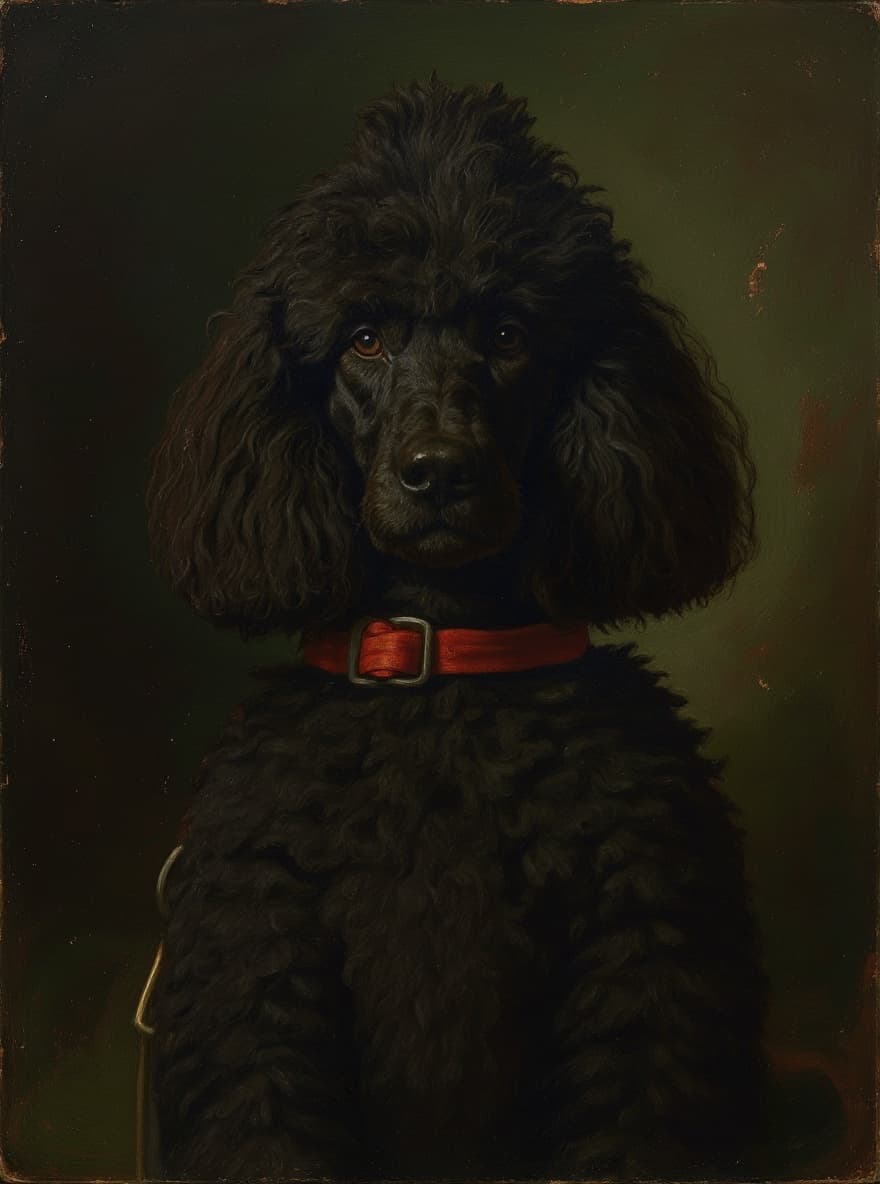
The poodle's association with the French court is so complete that it is easy to forget the breed was originally a working retriever, bred to enter cold water after shot waterfowl. The elaborate clip that became the breed's signature was a practical adaptation, the dense curls left on the joints and chest to protect against cold, the rest of the coat shorn for ease of movement in water. By the time the poodle reached Versailles, the clip had become pure theatre.
François Boucher painted poodles in the rococo tradition of the 1740s and 1750s, the breed appearing in pastoral scenes alongside silk-clad figures in idealized parkland. The coat, in Boucher's handling, becomes a vehicle for the same creamy, light-saturated paint surface he applied to clouds and skin. Jean-Baptiste Oudry, who served as official animal painter to Louis XV, produced more rigorous studies: the poodle as a formal subject, the coat's texture rendered with the same discipline he brought to dead game and hunting trophies.
The nineteenth century extended the breed's painted presence. In England, Edwin Landseer painted poodles with the sentimental naturalism that defined his practice. In France, Gustave Courbet included them in domestic scenes. The poodle's coat remained the central formal challenge: how to render the dense, curling texture without losing the form beneath it.
Our approach to the poodle follows Oudry more than Boucher. The coat is a formal problem first. We map the underlying structure before we address the surface, so that the finished painting reads as a dog with a remarkable coat rather than a coat with a dog somewhere inside it.
What the painted record tells us
Five centuries of painted dogs are not a random sample. The breeds that recur, the greyhound, the pug, the Cavalier spaniel, the poodle, recur because their physical and temperamental qualities answered specific pictorial needs. The greyhound gave the painter a line. The pug gave the painter a face that resisted flattery. The Cavalier gave the painter texture and an expression of composed attention. The poodle gave the painter a surface problem worth solving.
The painted record is also a social record. Each of these breeds carried meaning in the period when it was most painted. The greyhound signalled ancient lineage. The pug signalled continental trade and Baroque court culture. The Cavalier signalled Stuart loyalty. The poodle signalled Versailles and the French aristocratic tradition. When we paint these breeds now, we paint into that accumulated meaning, whether we intend to or not.
The best animal portraiture has always understood this. Van Dyck did not paint a dog; he painted the relationship between a dynasty and its chosen animal. Hogarth did not paint a pug; he painted a self-portrait by proxy. The breed is always also an argument about who its owner is, and what they value.
That argument continues in every portrait we make at the atelier. The breed you choose, and the style in which it is rendered, speak before the viewer reads a single label.