22 June 2026 · Maison Zola
Oil painting or print: choosing a medium for a pet portrait
Understand the real difference between an oil painting and a pigment print for a pet portrait — longevity, cost, and which suits your wall.
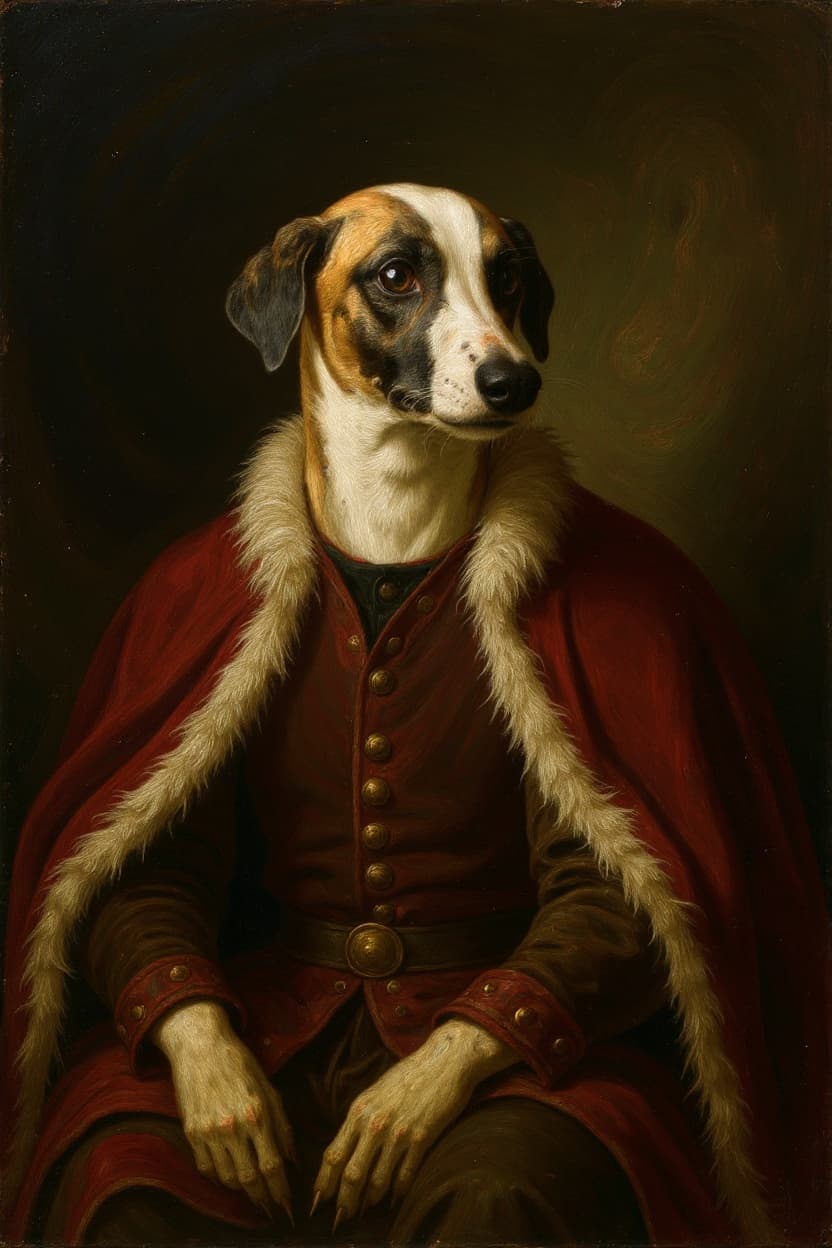
The question we hear most often
Someone receives a framed portrait as a gift. They run a finger along the surface and ask: is this painted, or printed? The question is not naive. The two things look closer than they once did, and the honest answer shapes everything that follows: how the piece ages, what it costs, and what it means to own it.
We are asked this often enough that it deserves a careful answer.
What the atelier actually makes
Maison Zola does not, at this tier, offer hand-painted oil commissions. What we make are archival pigment prints: digital paintings rendered at high resolution, then output onto acid-free paper or canvas using pigment-based inks. The distinction matters, and we will not paper over it.
The work begins as a painting in the digital sense. Our artists compose in layers, building form and light the way a studio painter would, referencing the same tonal vocabulary as the seventeenth century Flemish portrait tradition. The result is a finished image that carries the visual weight of oil. But the physical object is a print.
You can explore the full range of what we produce in our catalogue.
Three finishes, two substrates
Every portrait leaves the atelier in one of three configurations.
Fine art paper, matte finish. The substrate is a heavyweight cotton-rag sheet, the same family of material used for museum-quality photographic prints. The surface is uncoated, which means the image sits slightly in the paper rather than on top of it. Colours read as slightly more restrained, closer to the look of a gouache or a pastel. This finish suits portraits painted in a quieter, more intimate style.
Fine art paper, lustre finish. A light surface texture catches the light without producing glare. Colours read with more depth than the matte version. This is the finish most people choose when they want the portrait to hold its own in a well-lit room.
Canvas, textured finish. The image is printed onto a woven canvas substrate and finished with a protective coating. At close range, the weave of the canvas is visible. At normal viewing distance, the surface reads very much as a painting would. This is the finish that invites the question at the top of this piece.
All three are available framed or unframed. Frames are sourced from European suppliers and fitted with UV-filtering acrylic rather than glass, which reduces reflection and protects the print from light degradation.
Longevity: what the numbers mean
Pigment inks on archival substrates carry a rated lifespan of 80 to 200 years under normal display conditions, depending on the specific ink and paper combination. That figure comes from accelerated light-fade testing conducted by independent laboratories, and it assumes the print is not hung in direct sunlight or in a room with high humidity.
A hand-painted oil on linen, properly varnished and stored, can outlast that figure by centuries. The National Gallery holds oils from the fifteenth century that remain legible. That is the honest comparison.
For most domestic contexts, the practical difference is smaller than it sounds. A portrait hung in a living room, away from direct light, framed behind UV-filtering acrylic, will not show meaningful fading within a human lifetime. The 80-year floor is a conservative figure.
What changes with an oil is not just longevity but materiality. The paint has physical presence: impasto, the slight topography of a loaded brush, the way varnish deepens over decades. A pigment print, however well made, does not accumulate that history. The canvas finish approximates the surface; it does not replicate the substance.
Cost and what drives it
The price difference between a pigment print and a hand-painted commission is substantial, and the reason is straightforward. A hand-painted oil requires weeks of a single artist's time, expensive materials, and a physical object that cannot be reproduced. A pigment print requires skilled digital painting, high-quality output, and careful finishing, but the economics are different.
Our prints are priced to reflect the artistic work that precedes the output: the composition, the tonal study, the breed-specific rendering that we describe in more detail when discussing the oil painting style that informs our approach. The physical production is a separate cost, and an honest one.
For most clients, the print is the right answer. It delivers a finished portrait of genuine visual quality at a price that does not require the same commitment as a painted commission. The question is whether the distinction between print and painting matters to you, practically and emotionally.
When a print is the right choice
A print is the right choice when the portrait is intended as a gift, when the budget is fixed, when you want a consistent aesthetic across several pieces, or when the breed's character is the priority rather than the physical medium. Our custom pet portrait process is designed around exactly this use: one photograph, one portrait, one finished object delivered to your door.
It is also the right choice when the wall matters more than the object. A well-printed portrait on cotton-rag paper, in a considered frame, reads as a serious piece of domestic art. The room does not know the difference.
When to seek a hand-painted commission
If the physical object is the point, if you want the accumulating presence of oil on linen, the brushwork visible under raking light, the sense that a human hand moved across the surface over many sessions, then a pigment print will not satisfy that. No print does.
Hand-painted commissions exist, and they are available from ateliers that specialise in them. The cost is commensurately higher, the timeline is longer, and the result is a different category of object. We do not currently offer that tier, and we say so plainly.
What we offer is the visual language of the painted portrait, rendered with care, output on archival materials, and finished to a standard we stand behind. For the majority of the portraits we make, that is sufficient.
A note on the styles we work in
The medium question is separate from the style question. Whether the portrait is printed or painted, the composition can follow the formal vocabulary of a seventeenth century court portrait: three-quarter pose, dark ground, the subject occupying the painting's centre of gravity. Or it can be looser, more contemporary, closer to a studio study than a state commission.
The styles we offer are described in the catalogue, and the choice of finish should follow the choice of style. A Renaissance-register portrait reads better on canvas or lustre paper; a quieter, more intimate composition often suits the matte finish. These are not rules, but they are the observations of a studio that has made a great many of these decisions.
The honest summary
An archival pigment print is not an oil painting. It does not pretend to be one. What it is: a carefully made image on long-lasting materials, produced by artists who understand the portrait tradition they are working within, and finished to a standard that will hold up across a lifetime of display.
The choice of medium is ultimately a choice about what you want to own. Both answers are legitimate. Ours is the print, made well.