19 June 2026 · Maison Zola
Painting the Beagle: notes from the atelier
How the Beagle's tricolour coat, expressive eye, and hunting-hound lineage shape every decision in the studio. Notes on warm light, character, and the painted register.
The breed that sat for the English sporting tradition
The Beagle is one of the breeds with the longest continuous formal painted record in our atelier. The dog (or rather, the small scent hound the modern Beagle descends from) appears in English sporting painting from the seventeenth century onward, and the breed's painted vocabulary was established before the breed standard itself was. A Beagle portrait sits inside a tradition that predates the formal kennel-club recognition by a century and a half.
This is not antiquarian detail. It shapes the painter's decisions on the easel. The breed has been painted in a specific register (a warm tricolour palette, a calm domestic composition, a particular attention to the hound's pendant ear and intelligent eye) for so long that departing from that register reads as wrong even when the technical work is competent. We paint Beagles inside this tradition because it is the tradition the breed belongs to.
A brief history of the breed as a painted subject
The Beagle's history as a painted subject runs through the English country-house sporting tradition. Small scent hounds of the Beagle type appear in seventeenth-century English hunting prints and in the early eighteenth-century sporting paintings of John Wootton, who established much of the visual vocabulary that George Stubbs would later refine. By the time Stubbs was working in the second half of the eighteenth century, the small hound (whether called Beagle, Harrier, or Foxhound, the categories were not yet sharply distinguished) was a standard element of the country sporting composition.
Stubbs treated the small hounds with the same anatomical seriousness he gave to thoroughbred horses, and the painted record from the late eighteenth and early nineteenth centuries shows the Beagle as a working dog of genuine pictorial weight. Sir Edwin Landseer continued this register in the Victorian period, and by the time the modern Beagle breed standard was formalised in the late nineteenth century, the breed had a complete painted vocabulary already in place.
The American painted record adds a different note. The Beagle became one of the most popular American family dogs in the twentieth century, and the breed's painted treatment in the American context is often warmer and more domestic than in the English country-house tradition. We paint to both registers depending on what the family wants, but we tend to lean toward the warmer domestic treatment for American customers.
The coat: tricolour, lemon, and the warm hound palette
The Beagle's standard coat is tricolour: a black saddle across the back, with tan or chestnut on the flanks, head, and legs, and white on the chest, legs, and tip of the tail. The standard also recognises lemon (a pale yellow with white), red and white, and several less common patterns. The tricolour is what the breed has been painted in for three centuries, and we will start there.
The tricolour coat presents the painter with a tonal map that is, in our experience, one of the most rewarding to work with in the breed catalogue. The black saddle gives the painting a definite tonal anchor; the tan flanks and head carry the warm middle range; the white passages provide the highest values without the painter having to invent them. The painting almost composes itself if the tonal map is respected.
The challenge is the transitions. The Beagle's coat boundaries (black to tan, tan to white) are not hard edges. They are interleaved transitions that the painter has to render as paint rather than as drawing. We work these transitions wet-into-wet, scumbling the darker passages into the warmer surrounding tones with a soft brush. The boundary establishes itself through paint behaviour, not through line.
Lemon and red-and-white Beagles paint in a lighter register, with the warm pale coat reading against the dark Renaissance ground beautifully. We tend to paint lemon Beagles in slightly cooler studio light than the tricolour subjects, because the warm pale coat can read as too uniformly yellow under standard warm light and the cooler light brings out the individual hair group's variation.
The face: the long ear, the soft eye, the hound expression
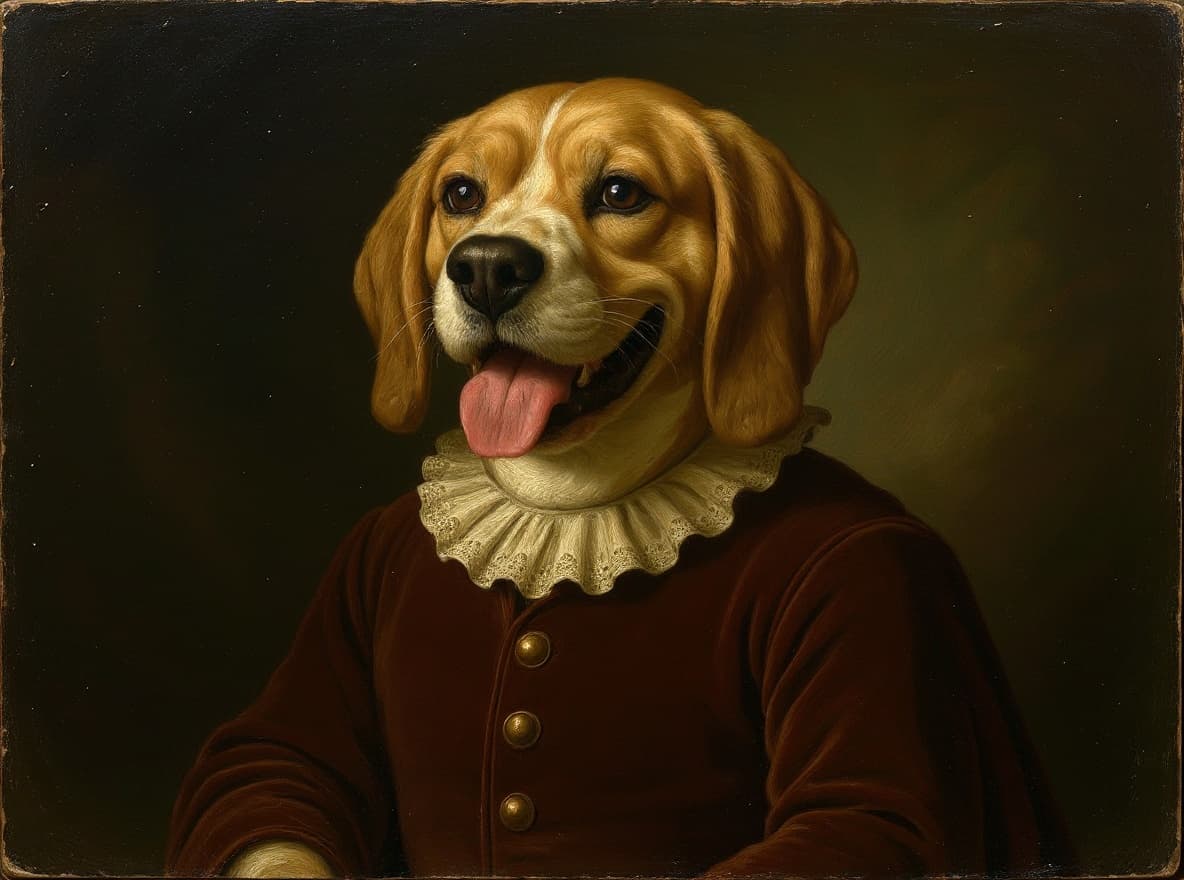
The Beagle's face is organised around the long pendant ears that frame the head and the soft brown eyes that carry the breed's gentle expression. The combination is the central painterly feature of the breed, and it is what most distinguishes the Beagle from the modernist-stylised illustrations the breed sometimes attracts.
We paint the ears with attention to the way they hang and to the warm reflected light on the inner ear surface. A Beagle's ear is heavier than it looks. The weight pulls the ear into a specific curved drape that the painter has to render as cloth-like rather than as flat shape. We work the ear with brushwork that follows the natural curl, and we keep the inner-ear highlight (a warmer reflected light against the darker outer surface) small enough to read as fact rather than as drawing.
The eye is the centre of the Beagle's expression. The breed's eye is brown, soft, and large relative to the face, and it carries the gentle, occasionally pleading quality that the breed is known for. The painter who renders this softness without tipping into sentimentality gives the family a portrait of their specific Beagle; the painter who pushes the soft eye too far produces a generic hound. We keep the eye highlight modest and place it at the upper edge of the iris, which preserves the eye's depth without flattening the gaze.
The muzzle is the third feature worth attention. The Beagle's muzzle is broad, the lips are slightly heavy, and the breed's characteristic mouth-slightly-open expression (often visible when the dog is at rest) is one of the small things that distinguishes the breed in paint.
Choosing a style for the Beagle
Of our three studio styles, the Beagle sits most naturally in the classical oil treatment. The reasons are essentially historical.
The classical oil register continues the English sporting tradition that the Beagle's painted vocabulary originated in. The warm tonal palette, the careful attention to coat and form, the slightly informal domestic composition (a dog at rest against a quiet ground rather than a dog in formal pose against ceremonial background): these are the elements the breed has been painted with for centuries, and the classical oil register continues that vocabulary directly.
The Renaissance treatment also works for the Beagle, particularly for tricolour subjects where the dark saddle absorbs the period's dark ground beautifully. We recommend this treatment when the family wants a more formal register than the classical oil; the result is a portrait that reads as period without departing from the breed's actual character.
The royal regalia treatment we recommend for the Beagle less often. The breed's character is too working and too domestic to wear ermine and gold without irony, and the result, while technically successful, often reads as costume drama. We will paint a Beagle in the royal register if that is what the family specifically wants, but we tend to argue against the choice as a default recommendation.
The photograph the breed requires
Two things matter most when photographing a Beagle for a portrait.
First, the angle. The Beagle's face is most expressive at a slight three-quarter angle, with one ear hanging slightly forward and one slightly back. This angle preserves the dimension of the muzzle and lets both eyes catch the light. A direct frontal shot can flatten the muzzle visibly; a profile shot loses the eye contact that the breed's expression depends on.
Second, the moment. A Beagle at rest, with the eyes alert but the body settled, gives the painter the calm composition the breed has been painted in for centuries. A Beagle in motion, mid-howl or mid-run, is a valid subject but it suits an illustration register more than a portrait one. We tend to ask for at-rest photographs as the primary reference, with motion photographs as secondary if the family has them.
A note on the working register
One thing we sometimes recommend, particularly for families with hunting Beagles or for memorial commissions of working dogs, is a more explicitly working composition. A Beagle in a field setting, with the head down or the ears alert at scent, can be painted in the same English sporting tradition that the breed's painted vocabulary originated in. We do this less often than the standard portrait treatment, but we do it occasionally, and the results sit happily inside the tradition.
For most family commissions, the standard portrait register suits the breed best. The working composition is a specific treatment for a specific reason.
Temperament as pictorial fact
The Beagle's temperament (friendly, curious, energetic, occasionally stubborn) is not particularly easy to render in paint, because the breed's defining behavioural traits are often kinetic rather than postural. A photograph of a Beagle at rest does not capture the energy that defines the breed in daily life.
Our approach, which most families respond to, is to let the at-rest composition carry an alertness that hints at the energy without showing it. The eye is fully open and watchful. The ear set suggests attention to something just outside the frame. The body is settled but ready. The portrait reads as the Beagle the family knows, even when the dog in the painting is not actively doing anything.
This is, in our considered view, the difference between a portrait that captures the breed and one that captures the moment. The moment is photographic. The breed is painterly. The custom dog portrait work we do for Beagle commissions tries to honour both, with the breed taking precedence where the two differ.