29 May 2026 · Maison Zola
Painting the Cavalier King Charles Spaniel: notes from the atelier
How the Cavalier's silken ears, soft brown eye, and four coat colours shape every decision in the studio, from period style to angle of light.
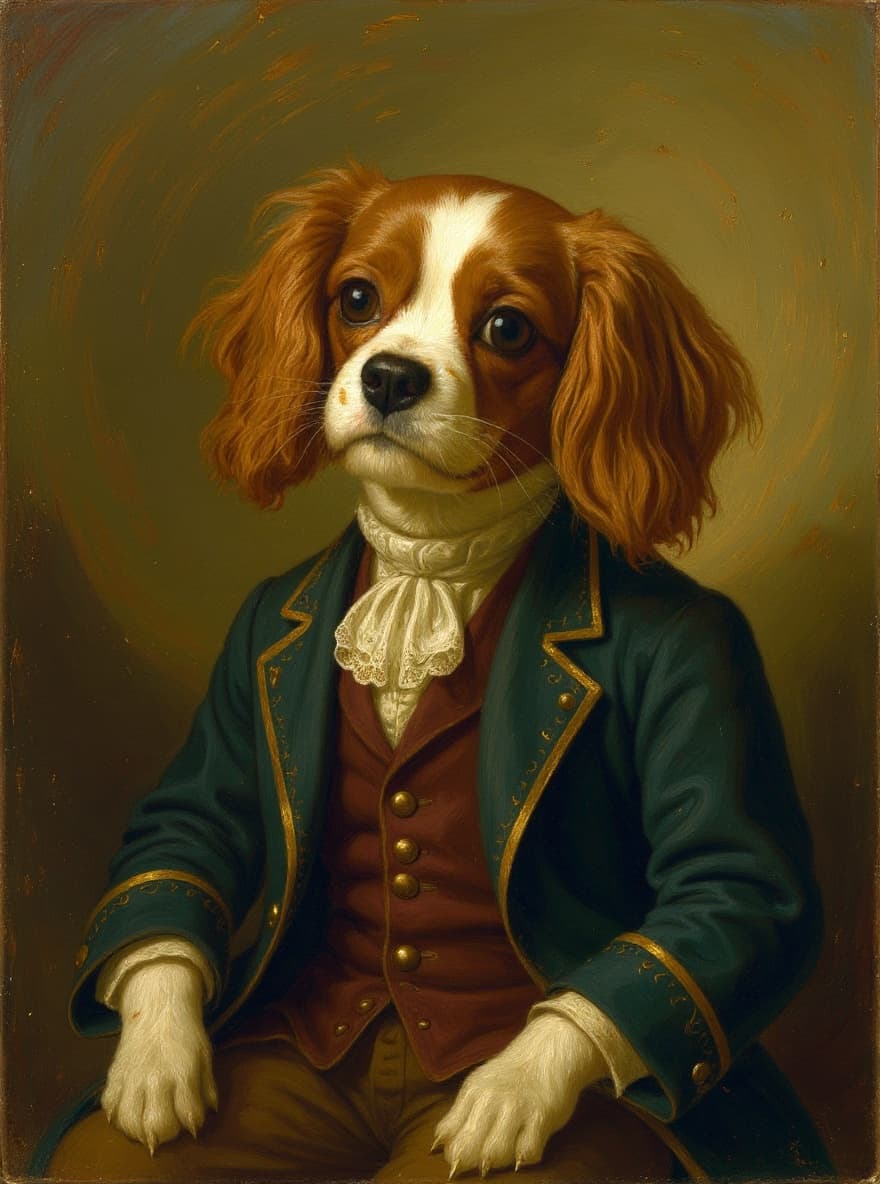
The dog the painters never had to argue about
A Cavalier King Charles Spaniel walks into the studio and the painter exhales. There is no problem. There has never been a problem. The breed has been sitting for portraits since the 1670s, and it has not learned a single bad habit in the intervening three hundred and fifty years. The ears fall the way they fall. The eyes do what the eyes do. The painter's only real job is to stay out of the way.
Most subjects need to be coaxed. The Cavalier arranges itself.
That is the first thing to know about a Cavalier King Charles Spaniel portrait, and it is the thing the older painters knew best. The breed is built for portraiture in a way that very few breeds are. The proportions are the proportions of a Stuart-era court painting. The colour palette is the palette of a Stuart-era court painting. We are not, on the whole, painting these dogs. We are repainting them, on top of a tradition the breed has already been part of for fourteen generations.
A brief, mostly seventeenth-century history
The breed is named for Charles II of England. That is not a small thing.
Charles, restored to the throne in 1660, was so attached to his small spaniels that they appeared in nearly every court occasion of his reign. His portraitists, principally Sir Peter Lely (who served as Principal Painter to the King) and the circle around the Dutch master Anthony van Dyck before him, painted the dogs alongside the King's mistresses with the same compositional weight they gave to the women themselves. The dogs were never decorative. They were participants.
The painting tradition stuck. By the late seventeenth century, an aristocratic English portrait of a woman without a small spaniel in it was almost unusual. The Cavalier became the dog of the boudoir, the bedroom, the lap, the lapdog in the most literal sense, and the painters of the period treated it as such. Soft light. Close framing. The dog and the sitter sharing the picture plane rather than one waiting at the feet of the other.
That is the lineage we are working from. The breed retreated from court life in the eighteenth and nineteenth centuries (the small spaniel that survived the period was structurally a different dog by 1900, with a flatter face and a heavier brow), and was deliberately bred back to the Charles II type in the 1920s by an American named Roswell Eldridge. The Cavalier you photograph today is closer to Lely's spaniel than to anything in between.
The body, which is the easy part. The ears, which are not
The body asks for very little. The Cavalier is small, compact, and well-proportioned. The painter places it on a velvet ground or a satin cushion, sets the directional light high and from one side, and most of the body painting is done.
The ears are different.
The Cavalier's ears are long, set high on the skull, and feathered with the same silken hair that grows along the legs and tail. The feathering is what the painter spends time on. Short-coated breeds give you flat passages of value to resolve. The Cavalier gives you the same problem a portraitist of a long-haired sitter has: long, soft, slightly differentiated planes of hair that catch light in directional bands.
We paint the ears in long passages of warm umber and ivory. The same brushwork a portraitist of the period would have used for the curl of a wig. The ears must read as soft, not stringy. The trick is to keep the brushwork itself relatively loose: the more you fuss with each strand of feathering, the more it reads as wire rather than silk.
There are four recognised coat colours: Blenheim (red-and-white), tricolour (black, white, and tan), ruby (solid red), and black-and-tan. Each presents the painter with a different problem. Blenheim is the easiest in oil; the red plays warm against an umber ground, and the white passages take the studio light cleanly. Ruby is more difficult in directional light because the entire dog reads as one warm mass without internal contrast, which is why we sometimes light a ruby Cavalier from slightly below to differentiate the chest from the body. The tricolour gives you the most visual information per square inch and is the most flattering to paint when the photograph has good light to begin with. Black-and-tan, the rarest of the four, sits comfortably in the Stuart-era palette and was almost certainly the colour Lely was painting most often.
The face
The face is, simply, the easiest face in the breed catalogue.
The skull is gently rounded. The muzzle is short but not compressed (the Cavalier was bred back specifically away from the flatter face of the King Charles Spaniel, which is a separate breed today). The eyes are large, dark, and set forward in the skull. The expression is, almost by genetic accident, the expression a Stuart court painter would have requested if you had given him a casting brief.
The eyes are where the painter's attention goes. The breed's eye is not just dark but soft, in a way that is hard to render without slipping into sentimentality. We mix the iris warm, towards mahogany, never black. The highlight sits at ten o'clock on the iris, the same position we use for almost every breed; that is not because the highlight is the most important part of the eye, but because it is the part the eye returns to once you have stopped looking at it for a moment, and a single misplaced highlight can flatten a face that should otherwise be carrying the whole portrait.
The mouth, very slightly open, with the lower lip relaxed, is the resting expression we want in the photograph. A closed mouth on a Cavalier reads as slightly tense; a fully open mouth shows the small teeth and reads as panting. The half-open lip is the breed's actual mid-rest face.
Choosing a style for the Cavalier
The Cavalier is one of the few breeds in our catalogue where the style recommendation is unambiguous.
The Atelier is the seventeenth-century Flemish and English vocabulary, dark grounds and warm chiaroscuro, and it is the style the breed was bred for. We paint Cavaliers in The Atelier more often than in either of the other two studio styles, and we recommend it for almost every commission. The dark ground throws the pale areas of the Blenheim and tricolour coats forward. The directional light catches the silken ears the way Lely caught them. The composition sits in a tradition the breed has been part of since its first portrait.
The Sovereign treatment, the coronation regalia and velvet, also works particularly well with this breed. The Cavalier is, after all, named for a king; the period costume that would feel theatrical on most dogs reads as historically appropriate on this one. We sometimes recommend The Sovereign for a ruby or black-and-tan Cavalier where the coat colour will play against the ermine and gold trim.
The Oil is the least Stuart-era of the three, but still works, particularly for a customer who does not want the period reference. The Oil treatment renders the breed as a classical animal portrait without committing to a specific century, which is a perfectly reasonable choice for a contemporary room.
What the photograph needs to give us
Every custom dog portrait begins with a photograph, and the Cavalier is forgiving about most of the photograph's requirements, with one exception.
The ears. The photograph has to show both ears falling cleanly. A Cavalier with one ear caught back behind the head, or with both ears flying forward because the dog was in motion at the moment of the shot, is much harder to paint than a Cavalier at rest. We can correct an ear position in oil up to a point, but past that point the painting starts to look like a different dog.
Beyond the ears: soft directional light (a north-facing window, a curtained lamp), a near-frontal angle ten to fifteen degrees off centre, both eyes visible, the half-open mouth at rest. Standard breed-portrait requirements, easily met.
One specific note. Avoid photographs taken from above. The Cavalier's skull is so small in proportion to the body that a top-down angle flattens the breed into an oval of fur with two ears attached. The dog needs to be photographed from approximately its own eye level, which is to say, low.
The breed in the long tradition
The Cavalier is one of the very few breeds whose painting tradition has been continuous for three and a half centuries. Most breeds entered the portrait record in fits and starts; the Cavalier has been there since before the modern dog show, before the kennel club, before most of the cities our customers live in.
There is something quietly satisfying about painting a Cavalier in the atelier style, given that. We are not establishing a tradition for the breed. We are participating in one. The painting that hangs on a wall in 2070 will trace its visual ancestry back to Sir Peter Lely's studio, and the small spaniel sitting on Charles II's lap will look very much like the small spaniel sitting on yours.
A successful Cavalier King Charles Spaniel portrait is, in the end, almost not the painter's work. It is the breed's.