13 June 2026 · Maison Zola
Painting the Dachshund: notes from the atelier
How the Dachshund's elongated silhouette, expressive eye, and three coat varieties shape every decision in the studio. Notes on proportion, light, and character.
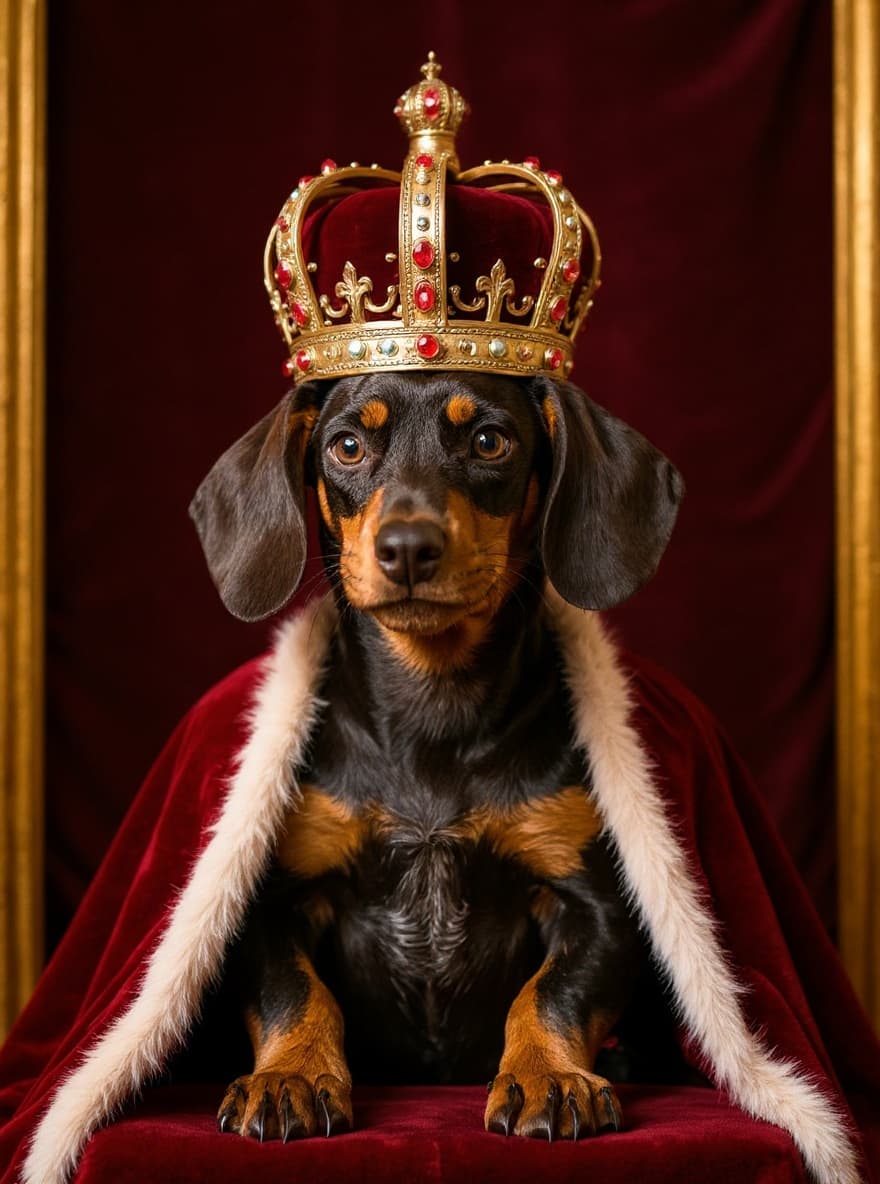
The breed that breaks the standard portrait rectangle
The Dachshund presents the painter with a problem that almost no other breed does. The body is roughly twice as long as it is tall. The standard portrait composition (a roughly square or slightly vertical canvas, with the subject's head occupying the upper third) does not fit the breed naturally. A Dachshund portrait that ignores this proportional fact will either crop the body so that the long back is invisible (in which case the breed's most distinctive feature is missing) or compress the body so that the proportions read as wrong (in which case the painting looks slightly off in a way the viewer cannot quite identify).
Our solution, in most cases, is a wider canvas. We paint Dachshunds at a horizontal aspect ratio more often than any other breed, with the composition organised around the long line of the back rather than around the vertical of the head. The result is a portrait that lets the breed be what it is, rather than forcing it into a rectangle that does not suit it.
A brief history of the breed as a painted subject
The Dachshund's painted record runs through several centuries of German hunting iconography. The breed was bred in Germany from the sixteenth century onward as a badger-hunting dog (the name translates literally as "badger dog"), and it appears in German hunting prints and woodcuts from at least the seventeenth century. The breed's distinctive silhouette made it a graphic shorthand for the German hunting tradition.
The Dachshund's broader European visibility began in the nineteenth century, when the breed became a fixture of German bourgeois domestic life. Queen Victoria's affection for the breed (her dachshund Dacko was a household fixture in her later years) accelerated its adoption across the English-speaking world, and by the early twentieth century the breed was a recognisable subject in formal animal portraiture across both German and English traditions.
The illustration tradition of the early twentieth century gave the Dachshund a particularly strong visual identity. The breed's graphic silhouette was used so often in children's book illustration, advertising, and editorial cartoon work that the modern viewer often sees the breed first as a stylised shape and only second as an actual animal. Part of the painter's job, in our experience, is to undo this. The Dachshund is not a shape. It is a specific animal with a specific gaze, and the portrait that respects this will read as a portrait rather than as an illustration.
The three coats: smooth, long-haired, wire-haired
The Dachshund standard recognises three coat varieties, and each presents a distinct painterly problem.
The smooth-coated Dachshund is the most common variety and the most demanding to paint well. The short coat offers no texture to absorb minor inconsistencies in brushwork, and every plane of the body must be resolved as a clean tonal modelling rather than as a textured passage. The smooth coat catches light in long warm planes (similar to a Whippet or an Italian Greyhound) and the painter who treats it as a uniform colour will produce a flat animal. We work the smooth coat in three or four value layers, with the highest values reserved for the chest and the top of the skull and the deepest values reserved for the shadow side of the body.
The long-haired Dachshund is the easiest of the three to paint at a competent level and the hardest to paint at the highest level. The feathered coat absorbs uncertainty, but it also requires careful attention to the way the long hairs lie on the body. A long-haired Dachshund painted without attention to the coat's actual flow direction will read as generally "fluffy" rather than as a specific animal. We study reference photographs particularly carefully for long-haired subjects, looking for the way the chest feathering separates and the way the tail's feathered underside catches light.
The wire-haired Dachshund is the most distinctive and, in our view, the most rewarding to paint. The harsh wire coat, the heavy eyebrows, and the characteristic beard give the breed a specific painterly identity that the other two varieties do not have. The wire coat reads best under directional light with strong contrast, where the individual hair groups separate visibly. We paint wire-haired Dachshunds with more visible brushwork than the smooth-coated variety, letting the marks describe the coat rather than disappearing into it.
The face: the eye, the brow, and the question of breed character
The Dachshund's face is small relative to the body, but it carries a large share of the breed's character. The eyes are dark, almond-shaped, and set forward, with a quality of attentive intelligence that the breed's hunting lineage has preserved. The brow, particularly in wire-haired and smooth varieties, carries a slight tension that suggests the breed is always thinking about something.
We paint the Dachshund's face with attention to the brow's tension. Underdone, the face reads as bland. Overdone, the breed tips into severity. The correct register is a quiet alertness, which is the breed's natural temperament rendered as paint.
The ears are floppy, set at the level of the eyes, and they frame the face without dominating it. We paint the ears with attention to the inner surface, which often shows pinker tones in the smooth-coated variety and feathered detail in the long-haired variety.
The muzzle is long and tapered, which gives the head a more refined shape than the body's heavy proportions might suggest. The Dachshund's head is, in fact, surprisingly elegant when isolated from the rest of the body, and we tend to give it slightly more painterly attention than the body proportions would suggest because the face is where the family recognises the specific animal.
The colour palette: red, black-and-tan, dapple
The Dachshund's coat colours offer the painter a wider range than most breeds. The standard colours include red (a warm reddish-tan), black-and-tan (a black body with tan points on the muzzle, chest, legs, and underside of the tail), chocolate-and-tan, and various dapple, brindle, and piebald patterns.
The red Dachshund paints most warmly, with the coat reading as a single warm colour that the painter can modulate through value alone. The black-and-tan variety paints almost as a duotone, with the contrast between the dark body and the tan points carrying the entire compositional weight. We paint black-and-tan Dachshunds with particular attention to the tan points around the eyes and muzzle, because these small warm passages give the otherwise dark face its expressive structure.
The dapple Dachshund (a coat pattern with lighter patches against the base colour) is the most painterly and the most demanding. The dapple pattern is irregular by definition, and the painter who treats it as a graphic pattern will produce a stylised animal. We paint dapple coats wet-into-wet, scumbling the lighter patches into the surrounding base colour and letting the boundaries soften through paint behaviour rather than through drawing.
Choosing a style for the Dachshund
Of our three studio styles, the Dachshund sits most happily in The Sovereign (royal regalia). The reasons are partly historical and partly compositional.
Historically, the breed has a long association with European royalty and aristocracy, particularly with the German and Austrian courts and with Queen Victoria's household. The royal vocabulary therefore sits naturally on the breed; there is no historical incongruity in painting a Dachshund in ermine and gold.
Compositionally, the royal style's emphasis on rich colour and elaborate fabric handles the breed's small face well. The fabric of the costume carries much of the painting's visual weight, which lets the painter concentrate the detail of the face without the body proportions creating an awkward composition.
The Renaissance register also suits the Dachshund well, particularly for the long-haired variety, where the silken coat sits naturally in the seventeenth-century Flemish vocabulary. The dark Renaissance ground throws the breed's silhouette forward, and the proportional issue is partly absorbed by the period's typical landscape or interior backgrounds.
The classical oil style we recommend for the Dachshund only for the smooth-coated variety and only when the buyer wants a contemporary register rather than a period one. The smooth coat handles the classical oil treatment well; the long-haired and wire-haired varieties read more naturally in the period registers.
The photograph the breed requires
Two specific things matter most when photographing a Dachshund for a portrait.
First, the angle. Because the body is so long, the angle from which the photograph is taken affects the proportions visibly. A photograph taken from too close, with a wide-angle smartphone lens, will distort the body further. We ask for photographs taken from a distance of roughly two metres, with the camera zoomed in, which produces a flatter and more accurate representation of the breed's actual proportions.
Second, the surface. The Dachshund's short legs mean that a photograph taken with the dog standing on a low surface (a bed, a sofa) often gives a better composition than one taken with the dog on the floor. The slightly elevated surface lets the painter see the line of the back clearly without the camera angle distorting it.
Once we have a good reference, we will often paint the breed in a setting that exaggerates the horizontal slightly (a window ledge, a long mantelpiece, a chaise), which suits the composition better than a vertical or square format does.
A closing note on the breed's specific charm
The Dachshund's charm is not generic. The breed is funny, watchful, often stubborn, and surprisingly dignified when allowed to be. The painter's job is to render this without tipping into the stylised, cartoon-shape territory that the breed's silhouette invites.
Of all the breeds we paint, the Dachshund is the one where the line between portrait and illustration is the easiest to cross. A good Dachshund portrait keeps to the portrait side of that line. It treats the animal as a specific subject worth careful attention, regardless of how readily its shape lends itself to a graphic shorthand. The breed deserves the same painterly seriousness we give to any other subject, and the portrait that gives it that seriousness rewards both the painter and the family who commissioned it.