11 June 2026 · Maison Zola
Painting the German Shepherd: notes from the atelier
How the German Shepherd's saddle markings, intelligent gaze, and noble silhouette shape every decision in the studio. Notes on light, coat, and presence.
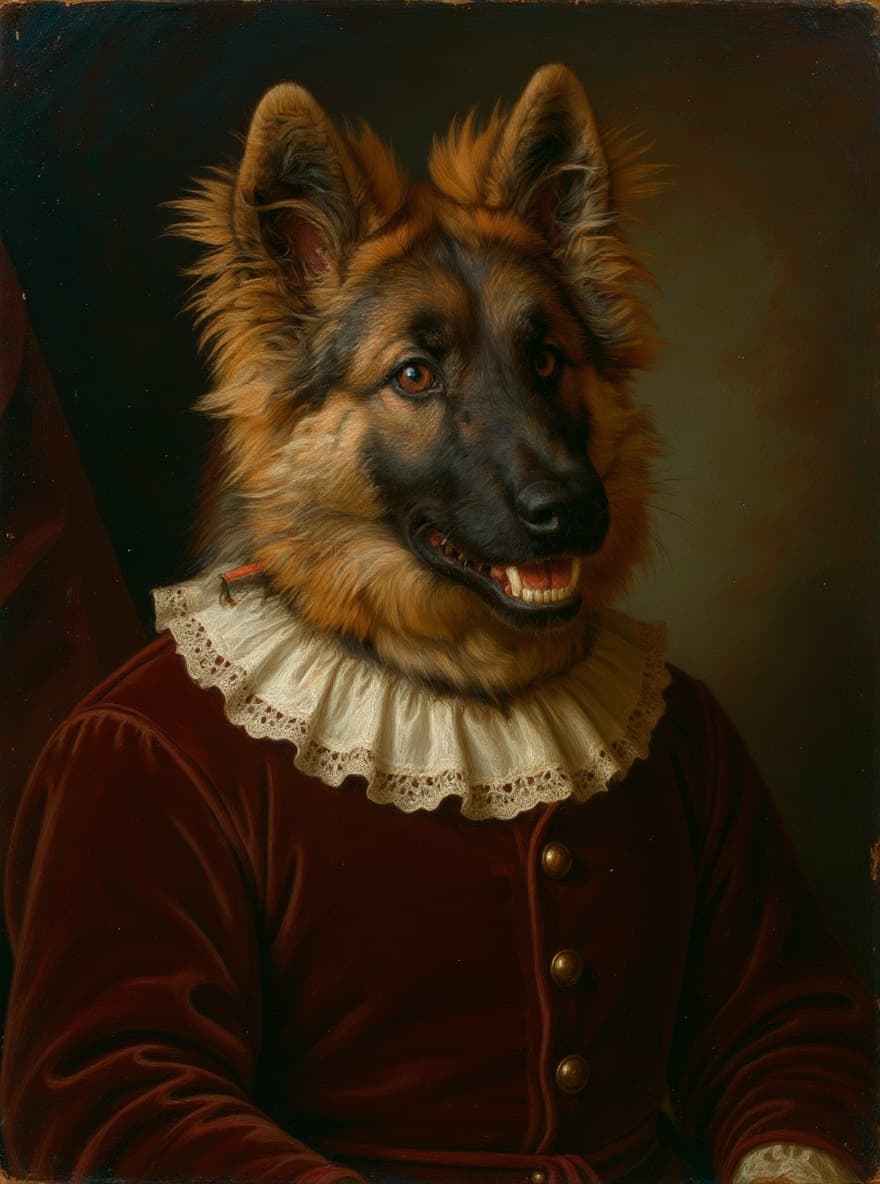
The breed that arrives composed and watchful
The German Shepherd does not unfold gradually on the easel. The breed arrives composed. The silhouette is already definite, the ear set already declarative, the gaze already direct. A German Shepherd portrait is, in our experience, less a problem of construction than a problem of restraint. The painter's task is to render what the breed is already doing rather than to invent additional drama for it.
This is not to say the subject is easy. The bicolour coat carries a specific painterly logic that flat-lit photographs tend to flatten entirely. The saddle marking moves across the back as a soft transition rather than a hard line, and the painter who treats it as a graphic shape loses the depth of the animal. We will come to that.
A brief history of the breed as a painted subject
The German Shepherd was formalised as a breed at the end of the nineteenth century, when Captain Max von Stephanitz consolidated several lines of German herding dogs into the modern standard. The breed's painted record is therefore shorter than that of the spaniels and the mastiffs, but it has accumulated quickly across the twentieth century, particularly in the iconography of working dogs and military service animals.
The German tradition of animal painting that the breed inherited (Rosa Bonheur's nineteenth-century animal studies, the Düsseldorf school's careful naturalism, and later the twentieth-century working-dog illustration of artists like Paul Pfungst) gave the German Shepherd a vocabulary of serious depiction from the start. The dog was not painted as a lap companion or a decorative subject. It was painted as a working animal whose presence carried weight.
That register is the one that suits the breed best in our atelier today. The light, comic, costume-heavy treatments that suit the Cavalier or the Pomeranian sit awkwardly on the German Shepherd. The breed asks to be taken seriously.
The coat: the saddle, the undercoat, and the soft transition
The German Shepherd's coat is the most painterly of any working breed we paint. The standard pattern (a black saddle across the back, blending into tan or sable on the flanks, chest, and legs) creates a tonal map across the body that is essentially a study in modelled transition. Done well, the saddle marking gives the painter everything they need to describe the form of the animal. Done poorly, it reads as a graphic outline rather than a painted passage.
The key is the boundary. There is no hard edge between the saddle and the surrounding coat. The dark hairs and the lighter hairs interleave across a transitional band that may span three or four centimetres of canvas, and the brushwork in that band has to read as fur rather than as a painted edge. We work this transition wet-into-wet wherever possible, scumbling the saddle's dark mass into the warmer surrounding tones with a soft brush and letting the boundary establish itself through paint behaviour rather than through draftsmanship.
The undercoat is the secondary problem. German Shepherds carry a double coat, and the soft pale undercoat shows through at the chest, the underside of the tail, and around the throat. This pale fringe is one of the most distinctive features of the breed in paint, and it is also one of the easiest to miss. A photograph taken under flat overhead light will collapse the undercoat into the topcoat. The painter who works only from such a photograph will produce a flat-coated dog that does not look quite right. We ask for at least one reference image taken under directional light precisely so the undercoat reads.
Black-coated and sable German Shepherds present different problems. The all-black variant is the hardest to paint well: the absence of tonal contrast across the body means the form has to be modelled almost entirely through reflected light, with cooler highlights on the planes facing the light source and warmer reflected light in the shadow passages. Sable Shepherds, by contrast, paint relatively easily, with the warm sable acting as a unified ground against which the saddle's darker markings sit.
The face: ears, eyes, and the controlled gaze
The German Shepherd's face is organised around two compositional facts. The ears are upright, large, and forward, framing the head with an architectural definition that most breeds do not have. The eyes are almond-shaped, medium in size, and dark in colour, and they carry an attention that is unmistakable when present and disappointing when absent.
We paint German Shepherds with the ears clearly defined and the highlight at the inner edge of each ear carefully placed. The inner ear catches reflected light from the surrounding environment, and the painter who renders this with restraint gives the breed the alertness that defines it. Overdone, the inner-ear highlight becomes a graphic line. Underdone, the ears recede and the face loses its frame.
The eyes are where the breed's character lives. The German Shepherd's attention is not the soft, sweet attention of a Golden Retriever. It is a controlled, intelligent attention that reads as watchful rather than greeting. The painter's job is to render this without tipping into severity. We tend to paint the eyes at a slightly warmer temperature than the surrounding face, with the highlight placed at the upper edge of the iris rather than centred, which preserves the depth of the gaze.
The muzzle is long, the bite is strong, and the mouth is usually painted closed. An open-mouth panting German Shepherd reads as a working dog in motion, which is a valid subject, but the formal portrait register suits a closed mouth better. The slight tension at the corner of the lip, just visible against the dark muzzle, is one of the small things that gives the breed its specific character in paint.
Choosing a style for the German Shepherd
Of our three studio styles, the German Shepherd sits most naturally in the classical oil register. The reasons are several.
The contemporary oil-painting vocabulary handles working dogs better than the costume-heavy Renaissance or royal styles. A German Shepherd in royal regalia reads, with respect, as slightly absurd. The breed's seriousness asks for a register that takes it seriously, and the classical oil treatment, with its restrained palette and its emphasis on careful tonal modelling, gives the breed exactly that.
The royal style we recommend for the German Shepherd only in specific cases, and only when the buyer wants the formal, ceremonial treatment for an explicit reason. A retired police or military service dog, for instance, can carry the royal vocabulary well, because the breed's working history sits inside the same lineage of formal recognition that the royal register comes out of. Outside that context, we tend to argue against the choice.
The Renaissance register suits the German Shepherd less well than either of the other two. The breed is too new (formalised in 1899) to sit naturally inside the seventeenth-century Flemish vocabulary, and the saddle marking does not absorb the period's deep dark grounds without the painting reading as too uniformly dark across the lower half of the canvas. We have made successful Renaissance commissions of German Shepherds, but they require a specific brief and a willingness to depart from the standard period palette.
The photograph the breed requires
Every commission begins with a photograph, and the German Shepherd makes specific demands on the source image. Three things matter most.
First, the light. The breed needs directional light from a window or open shade, not flat overhead light. Without directionality, the saddle marking flattens into a graphic shape and the undercoat disappears into the topcoat.
Second, the angle. A near-frontal angle, slightly off-centre, works best. The breed's ear set and gaze are most legible at this angle. Profile shots can work but they tend to emphasise the breed's silhouette at the expense of its character. We can paint from profile if that is what the family wants, but the conventional portrait angle is the safer choice.
Third, the moment. A photograph taken when the dog is at rest, with the gaze directed slightly above the lens (we suggest holding a small object at eye level beside the camera) gives the painter the controlled attention the breed is known for. Photographs taken mid-pant or mid-bark capture a different register that, while valid, suits a more energetic portrait style than the formal oil treatment.
Temperament as pictorial fact
The breed's temperament (intelligent, loyal, capable of serious work, capable of equal seriousness in family life) is not abstract. It registers on the canvas, in the way the head sits on the shoulders, in the carriage of the ears, in the controlled gaze. The painter's job is to render this as fact rather than as character note. A German Shepherd does not pose. It composes itself, and the painting that respects this composition will read as the breed regardless of which family it belongs to.
This is the difference, in our experience, between a portrait that the family responds to and one that reads as generic. The German Shepherd has too definite a character to survive generic treatment. The painter who renders the saddle without rendering the gaze will produce something that looks like a Shepherd-shaped dog. The painter who renders the gaze without the saddle will produce something that looks like a working dog of some kind. The portrait that succeeds renders both, and renders them as belonging to one specific animal.
A closing note on the breed's seriousness
Of the breeds we paint regularly, the German Shepherd is among the few that consistently rewards a quiet treatment. The breed does not need theatrical light, dramatic poses, or elaborate backgrounds. It needs careful tonal control, an honest study of the saddle marking, and respect for the breed's natural seriousness.
This is the register of our custom dog portrait work generally, and it is the register the German Shepherd reaches for most directly. We paint the breed in its own vocabulary, and we let the seriousness do the compositional work.