25 May 2026 · Maison Zola
Painting the golden retriever: notes from the atelier
How the golden retriever's feathered coat, soft eye, and spaniel lineage shape every decision we make at the atelier. Notes on oil, light, and form.
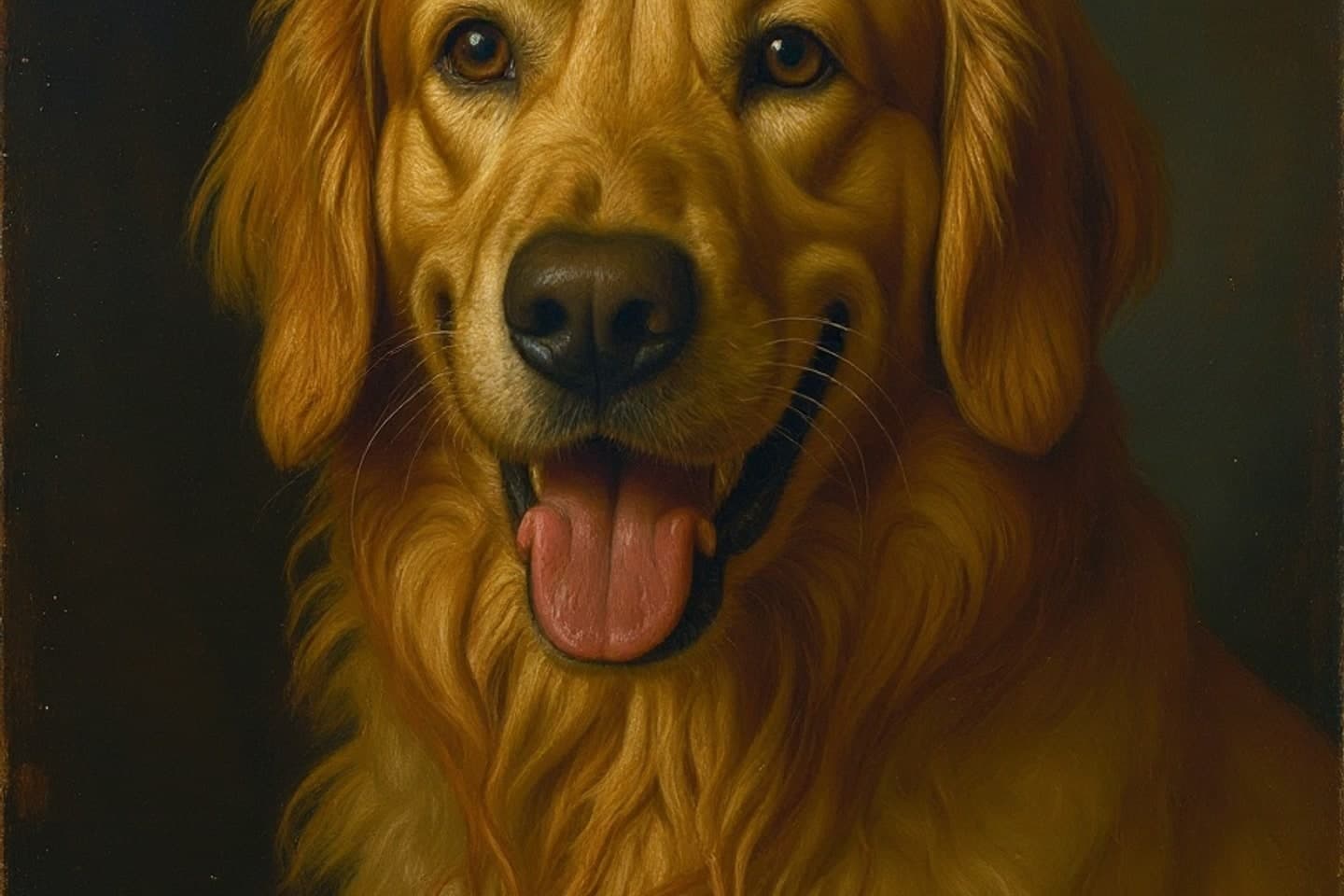
The coat as subject
Before the face, before the expression, there is the coat. The golden retriever carries one of the most demanding surfaces in animal portraiture: long, feathered, pale gold, and alive with reflected light. In a studio setting, that coat behaves less like fur and more like an oiled oak panel, catching the light source in long warm planes that shift from amber at the crown to near-white along the chest and forelegs. The painter who treats it as a single tone will flatten the animal entirely.
This is the first lesson the breed teaches. The coat is not a colour. It is a sequence of values, each passage slightly cooler or warmer than its neighbour, each one modelled against the dark ground behind it. The subject does not emerge from a golden retriever portrait through outline. It emerges through the slow accumulation of tonal relationships.
A lineage in Scottish sporting painting
The golden retriever as a distinct breed dates to the second half of the nineteenth century, to Lord Tweedmouth's careful crossings at Guisachan in the Scottish Highlands. The lineage runs through the wavy-coated retriever, the tweed water spaniel, and the Irish setter. Each of those progenitors had already found its way into British sporting painting long before the golden retriever had a breed standard.
Sir Edwin Landseer, working across the middle decades of the nineteenth century, understood the long-coated gundog as a subject of genuine pictorial weight. His retrievers and setters are not accessories to the hunt. They occupy the canvas with the same authority as the landscape behind them. The soft eye, the feathered leg, the slightly parted mouth: Landseer rendered these with a technical fluency that still sets the register for the breed in paint.
The broader tradition of Scottish sporting painting, from David Allan through the Victorian artists who followed Landseer, treated the working dog as a figure worthy of sustained attention. That tradition is the direct ancestor of the contemporary golden retriever portrait, even when the subject in question has never been closer to a grouse moor than a city park.
Why oil suits this breed
Not every breed rewards the same medium equally. The golden retriever is, in our considered view, one of the animals most naturally suited to oil painting. The reasons are technical before they are aesthetic.
Oil paint dries slowly, which allows the painter to blend adjacent tones while both are still wet. On a pale, long coat, this matters enormously. The transition from a lit passage on the dog's shoulder to the shadow pooling in the chest feathering is not a hard edge. It is a gradation that may span several centimetres of canvas, shifting through four or five intermediate values. Alla prima brushwork, worked wet-into-wet, is the natural vocabulary for this kind of modelling.
Oil also holds luminosity in a way that watercolour or pastel cannot quite replicate. The warm undertone of a golden coat, the way it seems to generate light rather than merely reflect it, comes from the depth of the oil medium itself. A thin glaze of yellow ochre over a dried warm ground reads differently from the same pigment applied in a single opaque layer. The atelier works in layers precisely because the breed demands it.
The challenge of light on form
The classical approach to painting a pale subject against a dark ground comes from the seventeenth century Flemish masters. Rembrandt's handling of a white linen collar, or the way a Jan de Heem still life brings a pale object forward out of deep shadow: these are the technical precedents. The principle is that the light passages are earned, not assumed. The painter builds from the dark ground outward, establishing the form in mid-tones before committing to the highest values.
Applied to the golden retriever, this means the brightest whites on the chest and the top of the skull are placed last, not first. The temptation is to lay in the pale coat early and model into it. The result, almost always, is a flat animal that sits on top of the canvas rather than within it. The correct sequence is the reverse: dark ground, warm mid-tone, cool mid-tone, then the selective application of light.
The face is the final priority. The breed standard uses the word "kindly" for the golden retriever's expression, and it is the right word. The softness around the eye, the slight heaviness of the brow, the open set of the mouth: these are the features that carry the portrait's emotional weight. We do not sentimentalise them. We paint them with the same deliberate attention we would give to any subject whose inner life is worth recording.
What the photograph must show
Every custom dog portrait we undertake begins with a photograph, and the photograph is the painter's first constraint. For the golden retriever specifically, the reference image needs to resolve the coat's detail in natural light. Overexposed images collapse the pale fur into a single white mass; underexposed images lose the warm tonal variation entirely. The ideal reference shows the subject in soft, directional daylight, with the coat's individual layers of feathering still legible.
We ask for multiple images where possible, not because we paint a composite, but because the coat's behaviour in different light conditions informs the painter's decisions even when only one reference is used as the primary source. A second photograph taken from a slightly different angle will often reveal a shadow passage or a highlight that the main image flattens.
The expression in the reference matters more for this breed than for almost any other. The golden retriever's face is expressive in a way that registers clearly in paint, and a photograph taken in the middle of movement will not give the painter the stillness the portrait requires. We look for the moment of rest, the settled gaze, the quality the Victorians called repose.
The dark ground as structural decision
The choice of background in a golden retriever portrait is not decorative. It is structural. A pale coat requires contrast to read as three-dimensional form, and the dark ground provides that contrast. This is not an arbitrary stylistic preference. It is the same logic that led Flemish and Dutch painters of the seventeenth century to set pale subjects against deep umber or near-black grounds: the light-on-dark relationship is what makes form legible.
We work most often with grounds in the range of raw umber to Vandyke brown, occasionally deeper toward black for subjects whose coat is particularly pale or whose expression benefits from a more dramatic tonal range. The ground is not painted flat. It is varied slightly across the canvas, warmer at the edges, slightly cooler behind the subject's head, so that the background reads as atmospheric depth rather than a painted wall.
This is the seventeenth century Flemish inheritance, applied to a breed that did not exist when those painters were working. The logic of the tradition holds regardless.
Temperament as pictorial fact
The golden retriever is not a neutral subject. The breed carries a temperament that has been selectively reinforced for more than a century and a half: attentive, patient, oriented toward the human it is with. These qualities are not invisible in paint. They are legible in the set of the head, the direction of the gaze, the slight forward lean that the breed adopts when it is paying attention.
Landseer understood this. His retrievers do not simply exist in their canvases; they are present in them, aware of the painter and of the viewer beyond the frame. That quality of attentiveness is what separates a portrait from a study, and it is what we pursue in every commission. The golden retriever, more than most breeds, offers the painter that quality without effort. The difficulty is not finding it. The difficulty is rendering it without allowing it to slide into the easy warmth that would make the portrait merely pleasing rather than true.
The coat catches the light. The eye holds the gaze. The painter's task is to keep both in balance, and to let the subject carry its own dignity forward across the centuries of the tradition it has, without knowing it, inherited.