31 May 2026 · Maison Zola
Painting the Labrador Retriever: notes from the atelier
How the Labrador's three coat colours, soft otter tail, and warm intelligent eye shape every decision in the studio, from light source to chosen style.
The dog that came in on a fishing boat
The Labrador walks into the studio and settles. Most dogs do not just settle, not on the first visit, not in an unfamiliar room. The Labrador, after about ten seconds of polite investigation, decides the studio is fine and lies down. This is, more or less, how the Labrador handles every new room it has ever been in, which is one of the reasons there are something like a hundred and twenty thousand of them in households in the United Kingdom alone.
The breed makes the painter's job easy in roughly the same way an old friend makes the photographer's job easy. There is no performing. There is no anxiety. There is just the dog, on the floor, paying mild attention to whatever is happening.
When a Labrador Retriever portrait arrives at the atelier, the work is mostly about restraint. The breed is so legible, so familiar, that the temptation is to overpaint, to add character where the breed has already given you all the character you need. The painter has to resist.
A brief, mostly nineteenth-century history
The Labrador is, despite the name, not from Labrador. It is from Newfoundland.
In the early nineteenth century, English fishing crews working the Grand Banks brought back the dogs they had seen retrieving in the cold Atlantic alongside Newfoundland fishermen. The dogs were short-coated, water-loving, and what the breed standard would later call "biddable," which is the English way of saying they listen. The Earl of Malmesbury bred them seriously starting in the 1830s. The Duke of Buccleuch picked up the line later in the century. By 1903 the Kennel Club had recognised the Labrador as a distinct breed.
This makes the Labrador a relatively recent painted subject, compared to the spaniels or the greyhounds. The earliest serious paintings of the breed are mid-nineteenth-century English sporting portraits, often featuring the dog with a duck or a partridge, in a country landscape with a shotgun balanced against a fence. Sir Edwin Landseer himself painted the related but distinct "Wavy-Coated Retriever" (later the Flat-Coated Retriever), and his circle painted Labradors in the same register.
The breed's twentieth century is largely an illustrative rather than a painted history. Maud Earl, Lucy Dawson, and later the postwar greeting-card industry produced thousands of competent Labrador images. The painted tradition, the formal animal portrait in oil, mostly let the breed go after about 1920. The atelier is trying, modestly, to bring it back.
The body
The Labrador has the easiest body in the breed catalogue to paint, and the easiest tail.
The body is, structurally, a working dog's body. Short dense coat, broad chest, strong legs, a back that is straight rather than dropped, a head that is set forward and slightly above the line of the shoulders. There is nothing baroque about the structure. The painter renders it cleanly and moves on.
The tail is the breed's quietly distinctive feature. The Labrador has what is called an "otter tail": thick at the base, tapering, rounded at the tip, covered in the same dense short hair as the body, and held more or less straight out from the spine. The otter tail is one of the breed standard's defining characteristics, and it is the easiest way to distinguish a Labrador from a Golden Retriever in a photograph where the face is ambiguous.
We paint the tail with the same flat warm underpaint we use for the body, and we let the dense coat read through the modulation of the underlying value. The tail should not be a separate compositional element from the body; it should be the body continuing.
The coat, in three colours
The Labrador comes in three coat colours, and each one asks for a slightly different studio treatment.
Yellow Labradors range from very pale cream to deep fox-red. The pale end of the range is the most demanding to paint in oil because the entire dog reads as a single warm tone unless the painter introduces enough modulation between lit and shadowed planes. We light yellow Labradors more directionally than the other two colours, with a clear shadow side, to give the painting structural information the coat alone does not provide.
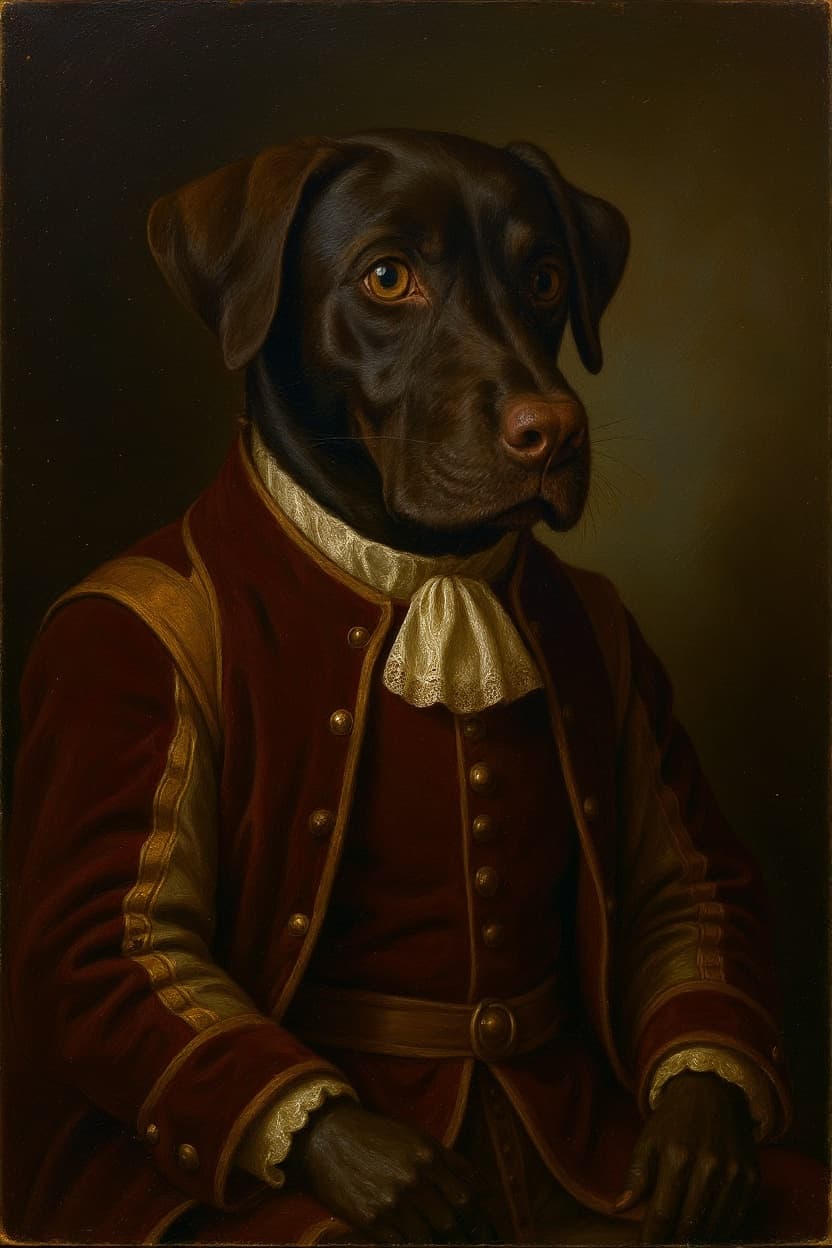
Black Labradors are, in our experience, the easiest of the three to paint well. The coat takes studio light cleanly. The shadows resolve. The whole dog has a kind of formal weight to it that suits The Oil treatment particularly well. The only trap is the same trap as the Rottweiler: a flat black coat, painted as a single tone, reads as a silhouette. We work black Labradors up from a warm umber underpaint, letting flecks of brown show through in the planes that face the light.
Chocolate Labradors sit between the other two for painting difficulty. The coat colour is warm enough to register against a dark ground but not so warm that it loses internal contrast. Chocolates often photograph better than they paint, in the sense that the photograph captures the warmth but the painter then has to work to keep that warmth from reading as muddy in oil. We use a slightly cooler ground for chocolates than for the other two colours, which gives the coat some space to read warm without flattening.
The face
The Labrador's face is, in one respect, the simplest face in the breed catalogue.
The skull is moderately broad. The muzzle is medium-length, neither compressed (like the Bulldog) nor elongated (like the Greyhound). The ears are set high on the skull and fall close to the cheek. The eyes are dark, set forward, and what the breed standard calls "expressive of intelligence and good temper." The breed standard is, on this point, accurate.
The painter's challenge with the Labrador face is not structural. It is emotional. The breed has an open, unguarded expression that is very easy to slip into sentimentality. A too-bright eye highlight, a too-soft brow line, and the painting reads as a calendar dog rather than a portrait. We mix the iris warm, the highlight modest, the brow firm. The expression in the finished painting should suggest the warm intelligence the breed actually has, not the cute warm intelligence the greeting-card industry has been selling since 1955.
The mouth, slightly open, with the tongue almost showing at the front edge, is the breed's resting expression. Photographs that catch the tongue out reduce the painting, in oil, to a kind of slack-jawed friendliness that is not what we are after. The mouth should be soft but closed, or very slightly open.
Choosing a style for the Labrador
The Labrador sits comfortably across all three of our studio styles, and we recommend the choice be made on the basis of room rather than breed.
The Oil is our default recommendation. The Labrador in The Oil reads as a serious painted dog without committing to a specific historical period. The treatment suits all three coat colours, and the breed's straightforward structure benefits from the formal directness of the style.
The Atelier treatment, the dark Stuart-era ground, works particularly well with black Labradors, where the coat can play against the warmer browns of the chiaroscuro. Yellow Labradors against the Atelier ground produce a slightly more dramatic painting than the breed naturally suggests, which can be the right choice for a dim room or a formal hallway.
The Sovereign treatment, with the coronation regalia, is the most unusual choice for this breed. The Labrador is not, historically, a court dog; the period costume can read as ironic on a breed whose actual job for two hundred years has been carrying birds out of cold water. We sometimes recommend The Sovereign for yellow or chocolate Labradors where the customer specifically wants the painting to play against the breed's working register.
What the photograph needs to give us
Every custom dog portrait starts with a photograph, and the Labrador is the most forgiving breed in the catalogue when it comes to source-photograph requirements.
The breed will hold a pose. The coat reads well in most lighting conditions. The face is legible from almost any angle that is not directly overhead.
That said, the requirements that improve any breed portrait still apply. Soft directional light from one side (a north-facing window is ideal). A near-frontal angle, ten to fifteen degrees off centre. Both eyes visible. Both ears in their natural position. The mouth closed or just slightly open.
One specific note for the Labrador. Photograph the dog when it is alert but not active. A Labrador on a walk, half-distracted by a smell, produces a less useful painting reference than a Labrador sitting indoors paying attention to you. The breed's working enthusiasm is one of its most painted qualities, but it is best painted from a still source.
The breed in the long tradition
The Labrador is the dog of the postwar century. More than a hundred million of them have lived and died in households since 1945. They have been on every family Christmas card, in every car insurance advertisement, on every box of dog food. The breed has been so thoroughly absorbed into ordinary domestic life that you can forget it is a serious painted subject.
It is a serious painted subject. Landseer's contemporaries knew it. Edwardian sporting painters knew it. The atelier's job is to remember it.
A successful Labrador Retriever portrait is a portrait of an individual Labrador, not a portrait of every Labrador. The breed's familiarity is the painter's enemy. The painter works against the type and toward the dog. The finished painting should hang on the wall as a likeness of a specific animal, with a specific expression, in a specific household.
That is the small but important difference between a Labrador on a wall and a Labrador on a Christmas card. We try, as much as we can, to be making the former.