1 June 2026 · Maison Zola
Painting the Maine Coon: notes from the atelier
How we approach the Maine Coon portrait in oil: the breed's ruff, tufted ears, and regal posture, and why the Renaissance style suits it best.
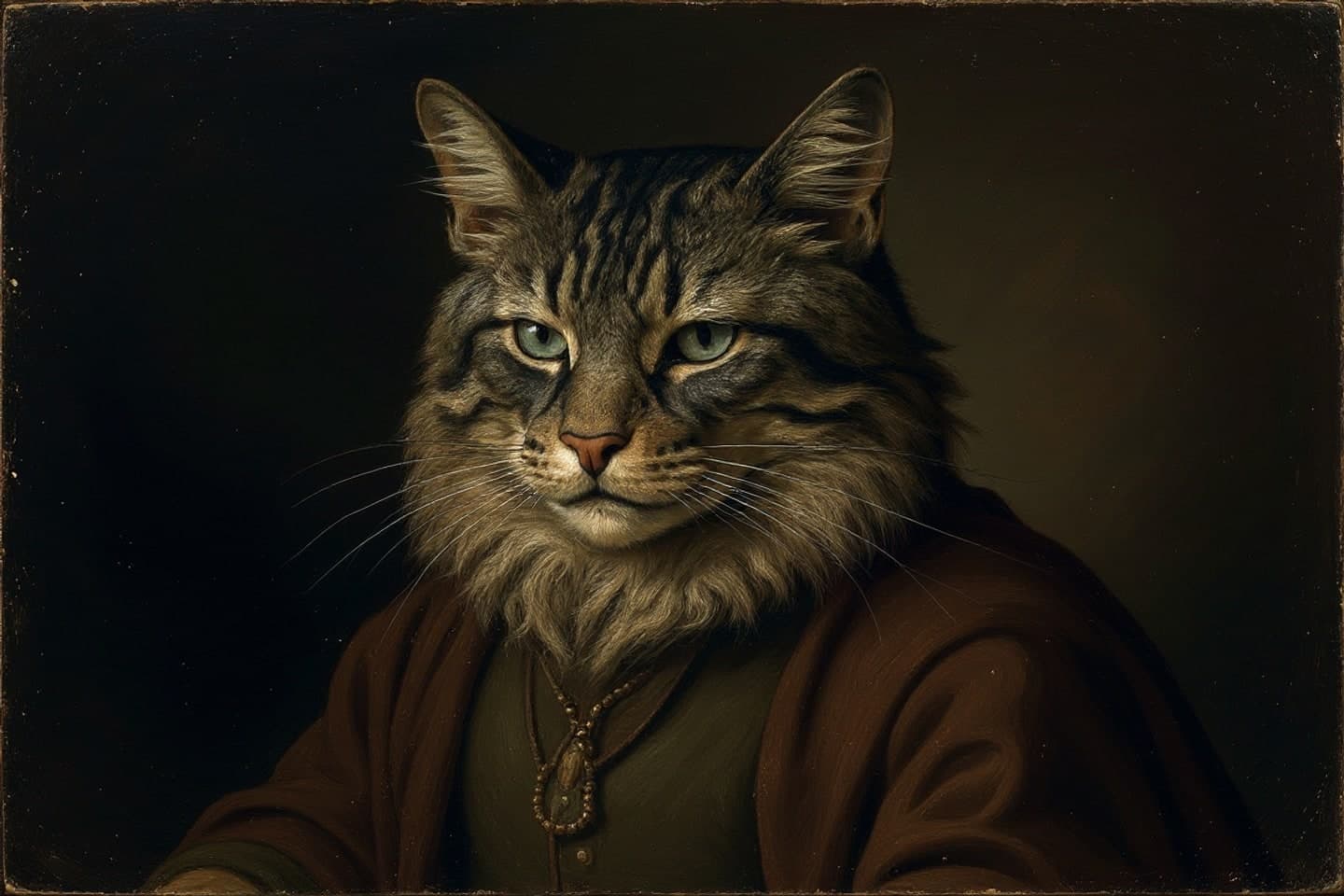
A late arrival in the portrait tradition
The domestic cat arrived in Western oil painting relatively late, and when it did, it arrived as a secondary figure. Manet's Olympia of 1865 places a black cat at the foot of the reclining model, alert and slightly insolent, more symbol than subject. Rosa Bonheur gave animals the full weight of academic painting, but her subjects were horses and cattle, creatures already coded as noble. The cat waited.
This lateness is not incidental. The dog had centuries of iconographic precedent: the loyal hound at a knight's feet, the spaniel in a Flemish interior, the setter in a Georgian sporting canvas. The cat had no equivalent tradition to inherit. It was a household presence, not a heraldic one, and painters treated it accordingly.
The modern atelier convention, the one we work within, corrects this. We paint cats with the same gravity we bring to any dog portrait, the same attention to posture, gaze, and light. The Maine Coon, in particular, makes that gravity easy to sustain.
The breed as a painter's subject
The Maine Coon is the largest of the domestic breeds, and it carries its size differently from most cats. Where a British Shorthair reads as compact and settled, the Maine Coon reads as expansive. The ruff around the throat, the tufted ears, the long, heavily furred tail: these are not incidental features but structural ones, the elements that give the breed its silhouette.
Painters have always been drawn to subjects that reward close looking. The Maine Coon is one of them. The coat alone contains a range of tonal values that a simpler-coated breed would not offer: the lighter guard hairs catching the studio light, the darker undercoat receding into shadow, the ruff catching a secondary highlight at the throat. This is the kind of material that slows a painter down in the best sense.
The eyes, set wide and slightly oblique, do most of the expressive work. They have a quality that the seventeenth century Flemish painters would have recognized: a calm, appraising attention that reads as intelligence without tipping into sentimentality. We paint them last, and we paint them carefully.
Why the Renaissance style suits the breed
When a client commissions a Maine Coon portrait, the question of style is not merely decorative. It concerns how the breed's character will be framed, and what the painting will ask of the viewer.
The Renaissance portrait works for the Maine Coon for reasons that are almost structural. The style's vocabulary, a dark studio ground, a three-quarter pose, warm passages of close-value tone, was developed to confer gravity on the subject. It does not require the subject to perform. The sitter simply occupies the center of the composition, and the composition does the rest.
The Maine Coon's natural posture is already formal. The breed tends to hold its head high, the ruff fanning out below the chin in a way that reads, without any artifice, as a ruff in the Elizabethan sense. Place that posture against a dark Flemish ground and the resemblance to a sixteenth century court portrait is not a conceit. It is a correspondence.
We paint the breed's actual features, not a generalized cat. The specific tilt of a particular Maine Coon's ear, the precise amber or green of the eyes, the way this individual's coat falls at the shoulder: these are the painter's materials. The Renaissance vocabulary is the frame, not the subject.
Slow brushwork and the long coat
The Maine Coon's coat asks for a different pace than a short-haired breed. A Siamese or a Russian Blue can be resolved in broad, confident passages; the coat reads as a single plane of color with a clear tonal logic. The Maine Coon cannot be resolved that way.
The ruff, the ear tufts, the feathered tail: each of these requires the painter to work in layers, building up the lighter hairs over a darker ground rather than placing them in a single pass. This is closer to the technique of the early Flemish masters, who built their surfaces in thin, successive glazes, than to the alla prima directness of a nineteenth century sketch.
We begin with the dark ground and work forward into the light. The deepest tones of the undercoat are established first, then the mid-tones of the main coat, then the lighter guard hairs, then finally the brightest highlights at the ruff and the tips of the ear tufts. At each stage the paint is allowed to dry before the next layer is applied. This is slow work, but the Maine Coon's coat repays it.
The face is always the priority. However complex the coat, the eyes and the set of the brow are where the painting either succeeds or does not. We spend more time on a square inch of the face than on a square foot of the body.
Working from your photograph
Every custom cat portrait we paint begins with a photograph supplied by the client. This is not a limitation; it is the method. The photograph captures what a sitting never could: the particular way this cat holds its head in its own household, the specific quality of light that falls on it at rest, the expression it wears when it is simply itself.
For the Maine Coon, we ask for photographs taken in good natural light, ideally with the cat at rest and the face fully visible. The coat's tonal complexity is difficult to resolve from a photograph taken in low or artificial light, where the values flatten and the texture disappears. A photograph taken near a north-facing window, or outdoors on an overcast day, gives us the material we need.
The three-quarter angle suits the breed well. It allows the ruff to read as a full shape, the near ear to show its tufting, and the eyes to carry their characteristic lateral set. A straight-on photograph tends to flatten the ruff; a pure profile loses the eyes. The three-quarter is the Renaissance portraitist's preferred angle, and it remains the most useful one.
The Flemish lineage and where we sit within it
Our atelier is in Mont de l'Enclus, in the Belgian province of Hainaut, a short distance from the towns where the Flemish portrait tradition was formed. Rubens worked in Antwerp. Van Dyck, who brought the Flemish manner to the English court and established the template for the aristocratic portrait in Britain, was born there too. The lineage is local to us in a way that is not merely rhetorical.
When we paint a Maine Coon against a dark ground in the Renaissance manner, we are painting into a tradition that has been practiced in this part of Europe for four centuries. The techniques are not historical reconstructions; they are a living practice, adapted to a subject the seventeenth century painters did not often consider but would, we think, have found entirely worthy of their attention.
The Maine Coon, with its ruff and its wide-set eyes and its quality of composed self-possession, sits in that tradition without effort. It requires no special pleading. The painting simply proceeds, and the breed's character does the rest.