17 June 2026 · Maison Zola
Painting the Poodle: notes from the atelier
How the Poodle's clipped silhouette, dense single coat, and aristocratic painted history shape every decision in the studio. Notes on light, texture, and tradition.
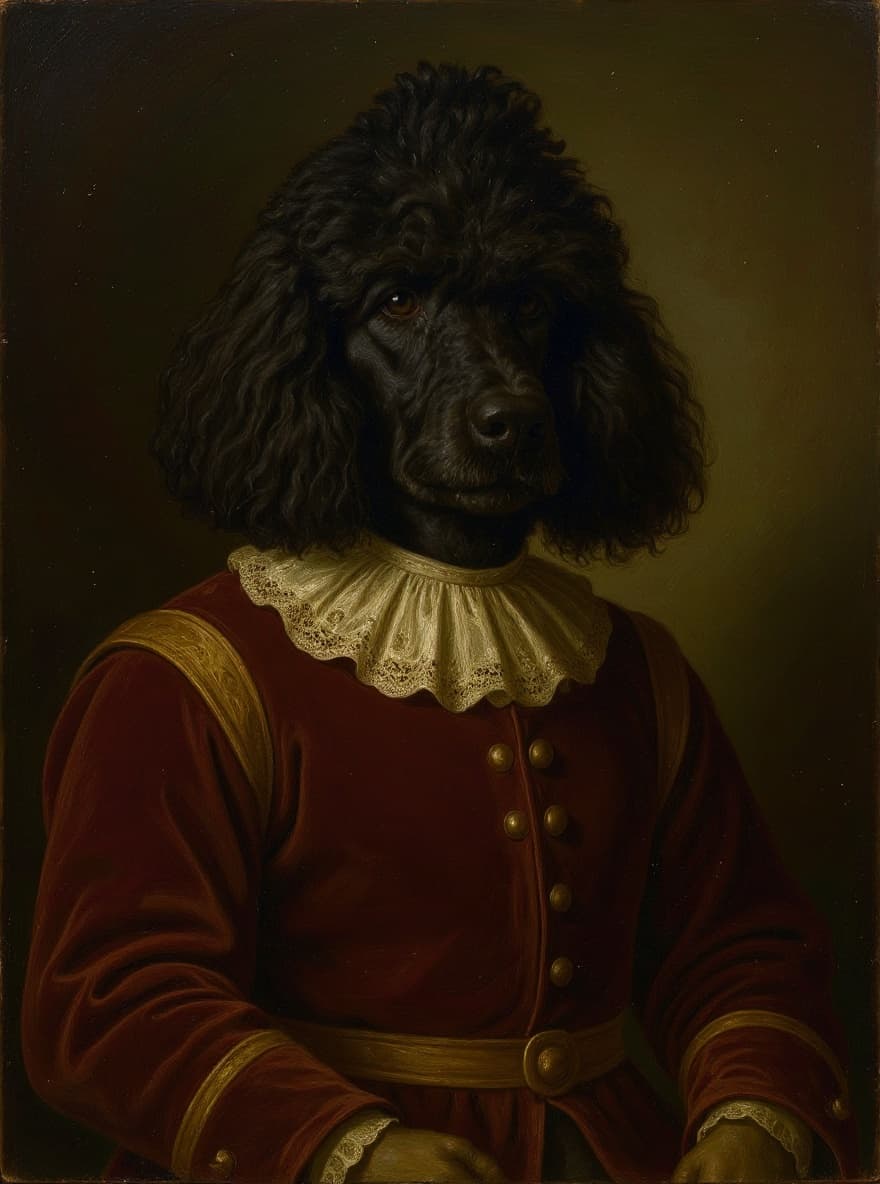
The breed with the longest formal painted record
Of every breed that walks through our atelier, the Poodle has the most decorated painted history. The dog appears in formal European portraiture from the seventeenth century onward, with a notable density of appearances in the eighteenth-century French and German court traditions. By the time the breed standard was formalised in the nineteenth century, the Poodle had already sat for two hundred years of formal portrait painters.
This depth of tradition shapes everything about how we paint the breed today. A Poodle portrait is not a contemporary invention. It is a continuation of an established register, and the painter who treats the breed casually betrays the lineage. We paint the Poodle with the formality it has always been painted with, regardless of which clip the dog is currently wearing.
A brief history of the breed as a painted subject
The Poodle's painted record begins in earnest with the Dutch and German water-dog tradition of the sixteenth and seventeenth centuries. The breed (whose name derives from the German Pudel, meaning "to splash in water") was originally a working retriever for waterfowl hunters in northern Europe. Albrecht Dürer's woodcuts include early water-dog figures that the modern Poodle descends from, and seventeenth-century Dutch genre painting includes the breed frequently in domestic and hunting scenes.
The French court of Louis XV elevated the breed from working dog to aristocratic companion in the early eighteenth century, and the painted record from that point forward is largely a French record. François Boucher, Jean-Honoré Fragonard, and the broader Rococo tradition included Poodles in salon paintings, hunting compositions, and formal portraits with regularity. The breed's clip (the elaborate shaved-and-pommed presentation that the modern viewer associates with the Poodle) was developed in this period as a hunter's adaptation, with the chest and joints kept covered for warmth while the hindquarters were shaved for swimming ease.
By the nineteenth century, the Poodle had moved across the Channel into the English portrait tradition and across the Atlantic into the early American animal-painting record. Sir Edwin Landseer painted Poodles in the same serious register he gave to retrievers and setters. The breed has been formally painted in every major European tradition for three and a half centuries, and we paint it today as a continuation of that record.
The coat: dense, single, and demanding
The Poodle's coat presents the painter with a specific problem that no other breed quite duplicates. The coat is single (no undercoat), dense, and curled, with a texture that catches light differently from any flat-coated or wire-coated breed. Done well, the coat reads as a sculpted volume with subtle modelling across the curls. Done poorly, it reads as a single texture-less mass.
The painter's task is to find the underlying form beneath the coat. A Poodle is, in clip, a series of geometric volumes (the chest cylinder, the leg poms, the topknot sphere) and the brushwork has to describe these volumes through the curl's interruption rather than through hard outline. We work the coat in three layers: a base value pass establishing the major light-and-shadow planes, a mid-value scumbling pass introducing the curl's texture, and a final layer of selective highlight where the curls catch the studio light.
The clip itself affects everything. A Poodle in continental clip (the traditional shaved-and-pommed presentation) requires the painter to handle the transitions between shaved skin and full coat with care. The shaved areas read as a different colour and texture than the coated areas, and the boundary between them is one of the most distinctive painterly features of the breed. A Poodle in puppy clip (the all-over even-length presentation) is more uniformly textured and slightly easier to paint, though less visually distinctive. A corded Poodle (the long matted-cord coat that some lines develop) is rare in our commission record but presents a different problem again: the cords have to read as cords rather than as a flat surface, and the brushwork has to carry the verticality.
The colour: black, white, apricot, and the question of light
The Poodle standard recognises a wide range of solid colours, including black, white, brown, apricot, red, silver, and several less common variants. Each requires a different approach in oil.
The black Poodle is among the most demanding subjects in the breed. The single-coat absence of undercoat means there is no warm under-layer to reflect in the shadow passages, and the form has to be modelled almost entirely through cooler reflected highlights on the planes facing the light source. We paint black Poodles with a higher proportion of warm reflected colour in the shadow areas than the photograph might suggest, because the eye reads warmth in the shadow as form rather than as colour, and the painting without that warmth flattens.
The white Poodle paints in the opposite register. The pale coat takes the surrounding studio colour easily, and the form has to be modelled through cool shadow rather than warm light. The challenge is keeping the coat from reading as flat white. We mix the white passages with subtle warm and cool variations, and we let the boundary with the dark Renaissance ground (where we use one) breathe rather than drawing it as a hard edge.
Apricot, red, and silver Poodles offer the painter the most warmth to work with, and they reward the period-style treatments particularly well. The warm coat tones sit naturally in the seventeenth-century Flemish palette, and the curl texture catches the period vocabulary's directional light beautifully.
The face: eye, expression, and the alert intelligence
The Poodle's face is, in our considered view, one of the most expressive in the canine world. The breed's intelligence is genuinely visible, in the way the eyes track movement, in the slight tension at the brow when the dog is thinking, in the alert set of the ears.
We paint the Poodle's face with attention to this intelligence. The eyes are dark, oval-shaped, and set forward, with a quality of attentive watchfulness that distinguishes the breed clearly from the soft-eyed retrievers or the high-energy terriers. The painter who renders this gaze accurately gives the family a portrait that reads as their specific dog; the painter who softens or generalises the gaze produces something that looks like a generic Poodle shape.
The expression most worth preserving, in our experience, is the slight forward lean of the head with the ears alert and the eyes focused. This is the Poodle in its characteristic working register, the posture the breed has been painted in for three centuries. A Poodle at rest is a different subject; a Poodle in this alert composition is the subject the formal portrait tradition has always rendered.
Choosing a style for the Poodle
Of our three studio styles, the Poodle sits comfortably in all three, but it sits most happily in the Renaissance register and in the royal register.
The Renaissance treatment suits the breed for the same reason it suits the Cavalier King Charles Spaniel: the breed has been painted in this vocabulary continuously for centuries, and the visual language fits without forcing. We paint Poodles in the Renaissance style with a slightly lighter overall palette than we use for darker breeds, particularly for white and apricot subjects, and the period's emphasis on careful modelling rewards the breed's textured coat.
The royal treatment is the most theatrical choice and one we recommend often, particularly for white and silver Poodles. The breed's association with the French court of Louis XV gives the royal vocabulary a specific historical anchor, and the breed's natural carriage suits ermine and gold without irony. A black or apricot Poodle in royal regalia can also work but requires more careful tonal balance to keep the dark coat from absorbing the costume's depth.
The classical oil treatment we recommend for the Poodle when the buyer wants a contemporary register rather than a period one. The treatment handles the breed well, particularly for dogs in puppy clip or with less elaborate presentations, and it produces a quieter, more domestic painting than the period registers do.
The photograph the breed requires
The Poodle's coat means that lighting in the source photograph matters more for this breed than for almost any other. Three specific things.
First, the light must be directional. The curls of the Poodle's coat read only when light catches them from one side; flat overhead light produces a textureless mass that gives the painter nothing to work from.
Second, the photograph must show the clip clearly. A Poodle photographed in groomed condition reads differently from the same dog photographed two months later, when the coat has grown out. We ask families to send photographs taken within a week or two of the dog's most recent grooming if possible.
Third, the angle should be near-frontal or slightly off. The breed's silhouette, particularly in continental clip, is so geometrically defined that a profile angle can read as ornamental rather than as portrait. The near-frontal angle preserves the breed's specific facial structure while showing enough of the clipped body to indicate the breed's distinctive form.
A closing note on the breed's seriousness
The Poodle is often, in contemporary cultural usage, framed as a decorative or amusing breed. This is a misreading. The Poodle is one of the most genuinely intelligent dogs we paint, and it has been treated with serious painterly attention for as long as the formal European portrait tradition has existed.
We paint the breed in this serious register, regardless of clip or colour or size variant. A Poodle is a portrait subject in the same fully formal sense that a Cavalier or a Mastiff is, and the painting that respects this gives the breed its proper inheritance. We are simply the latest painters in a three-century tradition. The breed's pose in the painting is one the breed has held in painted form since before any of us were born.