21 June 2026 · Maison Zola
Painting the Pug: notes from the atelier
How the Pug's flat face, expressive eye, and three-century court history shape every decision in the studio. Notes on the compressed muzzle, the wrinkled brow, and the painted register.
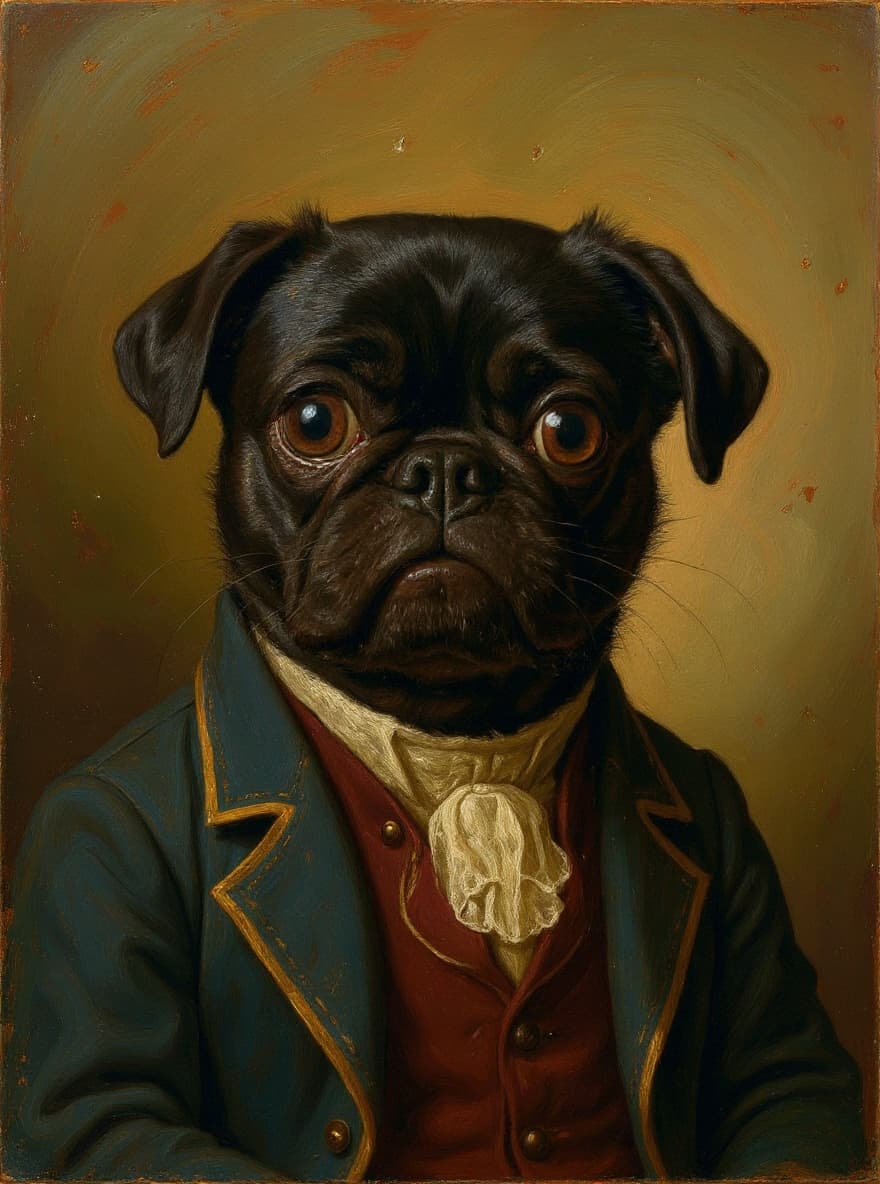
The breed that arrived at the European court
The Pug's history in formal painting is, surprisingly to most people, one of the oldest of any small breed. The dog arrived in Europe from imperial China in the sixteenth century, brought back by Dutch East India Company traders, and quickly became a fixture of the Dutch and German courts. By the seventeenth century the Pug was the official dog of the House of Orange (after a Pug named Pompey reputedly saved the life of William the Silent in 1572), and by the eighteenth century the breed had spread across the European aristocratic households as a companion of choice.
This is the painted lineage a Pug portrait inherits. The breed has been formally painted by William Hogarth (who painted his own Pug Trump in several major works), by Goya, by court painters of the Spanish, French, Dutch, and German aristocracies, and across the broader nineteenth-century domestic-portrait tradition. The Pug is, in painting history, one of the most-painted small breeds in European art.
A brief history of the breed as a painted subject
The Pug's painted record begins in Dutch and German court portraiture of the seventeenth century, where the breed appears at the feet of stadtholders and prince-electors with the same compositional weight as the hunting dogs in English country-house painting. The breed's compressed face and small body made it easy to include in formal portraits without compositional disruption; it could sit in a lap or beside a chair leg without interrupting the painting's organisation.
The eighteenth century gave the Pug its most distinguished painter. William Hogarth, the most important English painter of the period, owned a series of Pugs over his lifetime and painted them frequently. His self-portrait of 1745 includes his Pug Trump prominently in the foreground, and the dog has been a fixture of art-historical discussion ever since. Goya also painted Pugs in the Spanish court tradition of the late eighteenth and early nineteenth centuries.
The breed's American painted record is largely a twentieth-century one. The Pug became fashionable in early twentieth-century American society and has been a domestic-portrait subject since. The modern breed standard has shifted the dog toward a slightly more extreme version of the historical type (the muzzle is shorter and the eye is larger than in seventeenth-century examples), and the painter today works with a breed that is recognisably descended from but not identical to the dog Hogarth painted.
The face: the compressed muzzle, the wrinkled brow, the large eye
The Pug's face is the breed's defining feature, and it is the feature that most distinguishes the painter's task from any other breed in our atelier. Three things matter most.
First, the compressed muzzle. The Pug's muzzle is short to the point of being almost vestigial, and the face is dominated by the broad flat front and the heavy lower jaw. This compression presents a specific compositional problem: a near-frontal angle, which is the standard portrait angle, can flatten the face into a graphic mask if the painter is not careful. We paint the Pug at an angle of perhaps ten to fifteen degrees off centre, which preserves the dimension of the muzzle without losing the breed's characteristic facial symmetry.
Second, the wrinkled brow. The Pug's forehead is heavily furrowed, with the wrinkles forming a specific pattern that the breed standard treats as characteristic. The painter who renders these wrinkles as graphic lines produces a stylised face; the painter who treats them as soft tonal shifts in the underlying flesh produces a face that reads as a specific animal. We work the brow wrinkles in subtle value transitions, with the deepest wrinkle (the central vertical fold above the eyes) carrying the heaviest tonal weight and the surrounding wrinkles modulating into the surrounding skin.
Third, the eye. The Pug's eye is large, prominent, and dark, and it carries the breed's expression almost entirely. We paint Pug eyes with particular care. The highlight placement matters more than in most breeds because the eye is so prominent; the highlight set too high reads as glassy, the highlight set too low loses the curved-wet-surface quality. We place the primary highlight at the upper edge of the iris, slightly to the side of the light source, which preserves the eye's depth.
The coat: fawn, black, and the question of surface
The Pug's coat is short, smooth, and dense, with the standard recognising fawn (a warm tan with a black mask) and solid black as the principal colours. Each presents a different painterly problem.
The fawn Pug paints in a warm middle register. The body coat is essentially a single warm colour, modulated only by the black mask on the face and the dark line down the back. The painter's task is to render the body's form through subtle value shifts without breaking the visual unity of the warm coat. We work fawn Pugs with directional studio light, which gives the body its three-dimensional form without disrupting the coat's tonal unity.
The black mask is the principal painterly event on a fawn Pug. The mask runs across the muzzle, the ears, and around the eyes, and its boundaries with the surrounding fawn coat are not hard. They are interleaved transitions that the painter has to render as paint, with the dark hairs of the mask softening into the warmer surrounding tones across a millimetre-band that the brush has to handle wet-into-wet.
The black Pug paints in the same register as a black Poodle or any other solid-dark short-coated breed. The form has to be modelled through reflected light on the planes facing the light source, with the shadow passages carrying warm reflected colour rather than flat black. We paint black Pugs against a slightly warmer Renaissance ground than we use for fawn subjects, which gives the dark coat a context to read against.
Choosing a style for the Pug
Of our three studio styles, the Pug sits most naturally in the Renaissance register. The reasons are historical and compositional.
Historically, the breed has been painted in the seventeenth and eighteenth-century European court tradition continuously since it arrived in Europe. The Renaissance vocabulary, which draws on that tradition directly, sits on the Pug without forcing. The breed has been painted this way for four hundred years and our work continues that lineage.
Compositionally, the Renaissance treatment's dark ground throws the Pug's specific facial structure forward. The compressed face reads more clearly against the deep umber and Vandyke brown of the period palette than it does against the lighter grounds of the contemporary classical oil treatment.
The royal regalia treatment we recommend for the Pug regularly. The breed's association with European royalty is so well-documented in the painted record (the House of Orange, the French and Dutch courts, the English aristocracy) that ermine and gold sit on the Pug without irony. A Pug in royal regalia is, in our experience, one of the most successful royal-style portraits we produce, because the breed has been painted in this exact register for centuries.
The classical oil treatment we recommend for the Pug when the family wants a more contemporary, domestic register. The treatment handles the breed well, particularly for less elaborate compositions, but it is the least historically anchored of the three options for this breed.
The photograph the breed requires
The Pug's compressed face means that photograph angle matters more for this breed than for almost any other. Three specific things.
First, the angle. A direct frontal shot can flatten the face into a mask; a profile shot loses the symmetry of the eyes. The optimal angle is roughly ten to fifteen degrees off centre, which preserves the muzzle's dimension and shows both eyes catching light. We will paint from any angle the family sends, but we will often request a re-shoot at this preferred angle if the original photograph is at a flatter or more profile-oriented position.
Second, the light. The wrinkled brow needs directional light to read. Flat overhead light flattens the wrinkles and produces a smooth-looking face that does not match the breed. We ask for window light from one side, at roughly a forty-five degree angle to the face.
Third, the moment. A Pug's expression at rest tends to be slightly stern or contemplative; a Pug mid-pant produces an open-mouth panting expression that, while charming, sits awkwardly in the formal portrait tradition. We tend to ask for an at-rest photograph as the primary reference, with the dog's eyes alert and the mouth closed or barely open.
A note on breed character
One thing worth saying about the Pug, because the modern cultural reading of the breed sometimes obscures it. The Pug is a dignified breed. The dog has been the official companion of European royalty for four hundred years, and it carries the bearing of a breed accustomed to formal company. The contemporary internet treatment of the Pug as a comedy animal is, in painting terms, a misreading. The painter who treats the breed this way produces a caricature; the painter who respects the breed's actual register produces a portrait.
We paint Pugs in the dignified register the breed has always been painted in. The dog is funny, certainly, in the way that any dog with a strong specific character is funny, but the painting is not the place to render that. The painting is the place to render the breed's serious presence, which the Pug has carried in formal portraiture for four centuries. Our custom dog portrait work for Pug commissions tries to honour this inheritance, regardless of whether the family commissioning the portrait is thinking about Hogarth or about the dog at their feet.