15 June 2026 · Maison Zola
Royal pet portraits: a history of courts and their animals
From Tang dynasty Shih Tzu to Queen Victoria's Landseer commissions, royal courts have always painted their animals. Here is that tradition and what it means today.
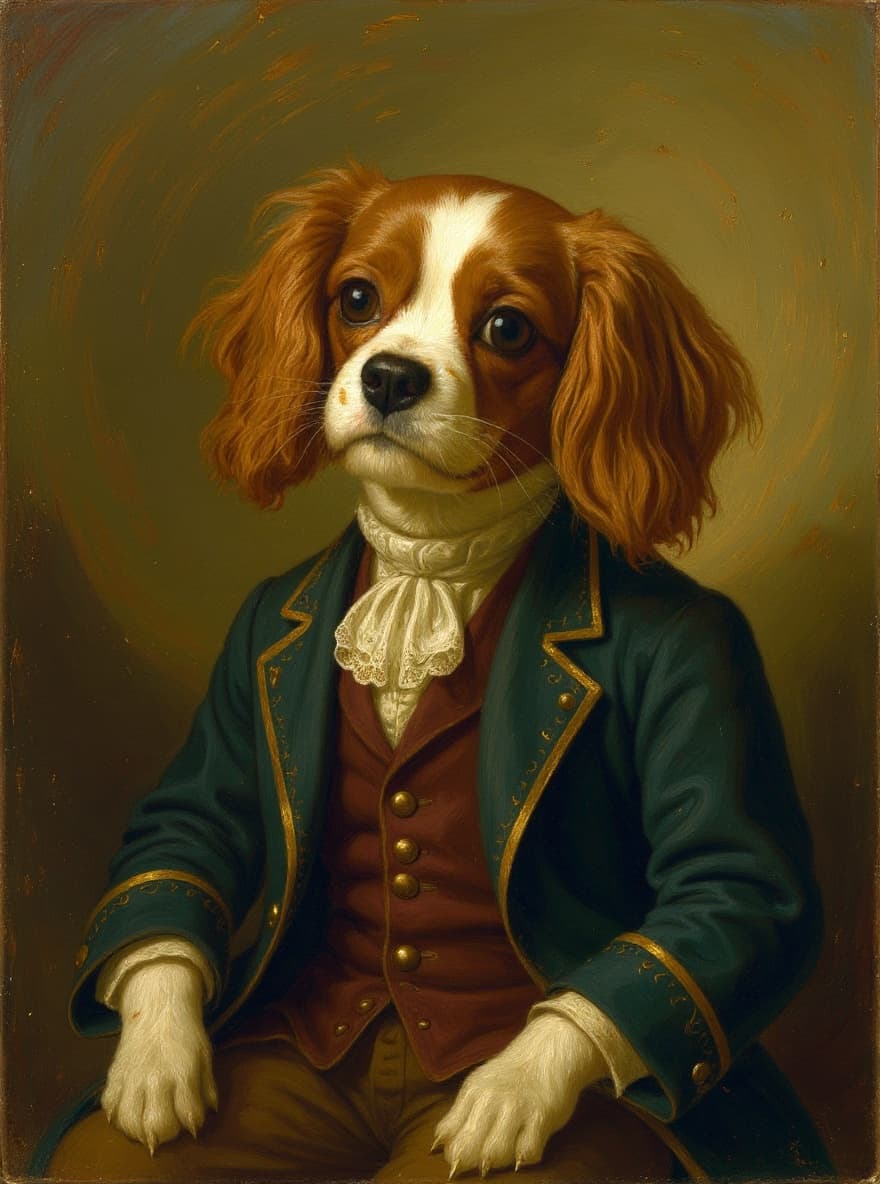
The court animal as subject
In the summer of 1841, Sir Edwin Landseer completed Eos, a portrait of Prince Albert's greyhound painted against a dark ground with Albert's top hat and gloves placed nearby as props. The dog occupies the canvas with the same composure as any human sitter. The painting now hangs at Windsor Castle. It is not a curiosity from the margins of art history; it is one of the defining statements of what a portrait can do when the subject happens to have four legs.
This is the tradition the royal pet portrait at our atelier draws from. Not a novelty, not a costume party. A long, serious lineage of courts that understood the animal beside the throne as worthy of the same pictorial gravity as the throne's occupant.
Tang and Ming: the imperial small dog
The Shih Tzu and the Pekingese were palace animals long before any European court took notice of the small companion dog. Tang dynasty records from the seventh and eighth centuries describe lion dogs kept within the imperial compound, bred for their dense coats and their flat, wide faces. These were not hunting dogs or working animals. They were prestige objects, living emblems of imperial refinement, and they were painted accordingly.
By the Ming period, the tradition had deepened. Court painters rendered small dogs in the meticulous gongbi style: fine brushwork on silk, every hair delineated, the animal posed with the stillness of a ritual object. The background was often plain, or suggested rather than described, so that nothing competed with the subject. The compositional logic is not so different from a Flemish portrait of the same era.
The Shih Tzu carries this history in its face. The wide-set eyes, the dense fall of coat, the particular dignity of a small animal that has never been asked to work for its keep. When we paint the breed in the royal style, we are painting into a lineage that predates the Stuart court by several centuries.
The Mughal hunting portrait
The Mughal emperors of the sixteenth and seventeenth centuries maintained ateliers of considerable sophistication, blending Persian miniature traditions with naturalistic European influence after the Jesuit missions brought Flemish prints to the subcontinent. Akbar and Jahangir both commissioned detailed animal studies: cheetahs on leashes, falcons on the wrist, horses in full profile. Jahangir in particular was a careful observer of the natural world, and his court painters reflected that attention.
The Mughal animal portrait is not sentimental. It is documentary in its precision and ceremonial in its framing. The animal is shown as a possession of the court, but also as a subject in its own right, worthy of careful description. That tension between the animal as symbol and the animal as individual is one the portrait tradition has never fully resolved, and does not need to.
Charles II and the breed that carries his name
No royal association between a monarch and a dog is more literal than the one encoded in the name of the Cavalier King Charles Spaniel. Charles II was observed by Samuel Pepys to be so devoted to his spaniels that he brought them into council meetings and attended to them during affairs of state. The breed appears in portraits of the period not as incidental detail but as a recurring compositional element, the soft-eared dog at the knee of the sitter, present as a sign of rank and temperament both.
Anthony van Dyck had painted Charles I with similar animals in the decade before. Van Dyck's court portraits established the visual grammar that would govern royal portraiture for two centuries: the three-quarter pose, the dark ground, the subject occupying the picture plane with unhurried authority. The dog at the knee was part of that grammar. It signaled leisure, refinement, the kind of life that allowed for attachment to a creature of no practical use.
The Cavalier today reads as a Stuart dog partly because of those paintings. The long ears, the soft expression, the tendency to arrange itself with a kind of unconscious elegance: these are the qualities Van Dyck's brushwork preserved.
Queen Victoria and the Landseer commissions
Victoria's relationship with Landseer was one of the most productive artist-patron relationships of the nineteenth century, and much of it concerned animals. Landseer painted her dogs, her horses, her deer. He painted Windsor Castle in Modern Times in 1843, in which Victoria and Albert are shown in a domestic interior with several dogs arranged around them, dead game birds on the floor, the whole scene a careful argument that the royal family was also a family in the ordinary sense.
Landseer's technique was academic in the best sense: controlled drawing, careful attention to the specific character of each animal's face, a refusal to generalize. His dogs do not look like dogs in the abstract. They look like particular dogs with particular expressions. That specificity is what separates a portrait from an illustration, and it is what Victoria was commissioning when she sat for him.
The Landseer tradition ran through the Victorian period and left a mark on how the British understood the relationship between the household and its animals. The dog was not merely tolerated in the portrait; it was a subject, sometimes the primary subject, rendered with the full resources of academic oil painting.
The frame and the posture: what the royal style actually means
The royal portrait is a compositional argument before it is anything else. The deep burgundy or midnight blue backdrop pushes the subject forward. The crown, the ermine trim, the suggestion of a gilded throne behind: these are not jokes at the animal's expense. They are the visual vocabulary of state portraiture, borrowed deliberately and applied with a straight face.
The posture matters as much as the costume. A royal portrait requires the subject to occupy the center of the canvas with authority. In human portraiture of the sixteenth and seventeenth centuries, this was achieved through pose direction, through the angle of the chin, through the placement of the hands. In animal portraiture, it is achieved through the painter's choice of reference and the handling of the face.
We paint the breed's actual features. The heavy brow of a French Bulldog, the long ears of a Cavalier, the dense coat of a Shih Tzu: these are not softened or idealized. They are painted as a seventeenth century portraitist would have painted a human face, with close attention to what makes this subject different from any other. The costume is the frame. The face is the painting.
Why courts kept painting their animals
The question worth asking is not why a court would commission a portrait of a dog, but why the practice persisted across such different cultures and periods. The Tang imperial court, the Mughal atelier, the Stuart painters, the Victorian academicians: these are not connected by a single tradition. They arrived at the same conclusion independently.
The answer is probably that the animal beside the powerful person says something the powerful person cannot say directly. It signals the capacity for attachment, for loyalty, for the kind of feeling that does not translate into policy or proclamation. The dog at the knee in a Van Dyck portrait tells the viewer that the sitter is capable of tenderness. The greyhound in Landseer's Eos tells the viewer that Prince Albert's household had room for grief.
Portraiture has always been partly about what the subject chooses to be seen with. The animal is a choice, and it is a revealing one.
Painting into the lineage
Our atelier sits in Mont de l'Enclus, in the Belgian province of Hainaut, within the same geographic tradition as the seventeenth century Flemish painters whose court portraits established so much of the visual vocabulary we still use. When we paint a royal portrait, we are working in that lineage: the dark ground, the three-quarter pose, the attention to the specific face of a specific animal.
The crown is theatrical. The ermine is theatrical. But the face, rendered in oil on archival materials from a photograph you provide, is as serious as anything Landseer or Van Dyck put on canvas. The tradition is long. The subject, in every case, was worth the attention.