6 June 2026 · Maison Zola
How to choose between the three studio styles, when you cannot decide
A working painter's decision tree for choosing between The Atelier (Renaissance), The Sovereign (royal regalia), and The Oil (classical) for a custom dog portrait.
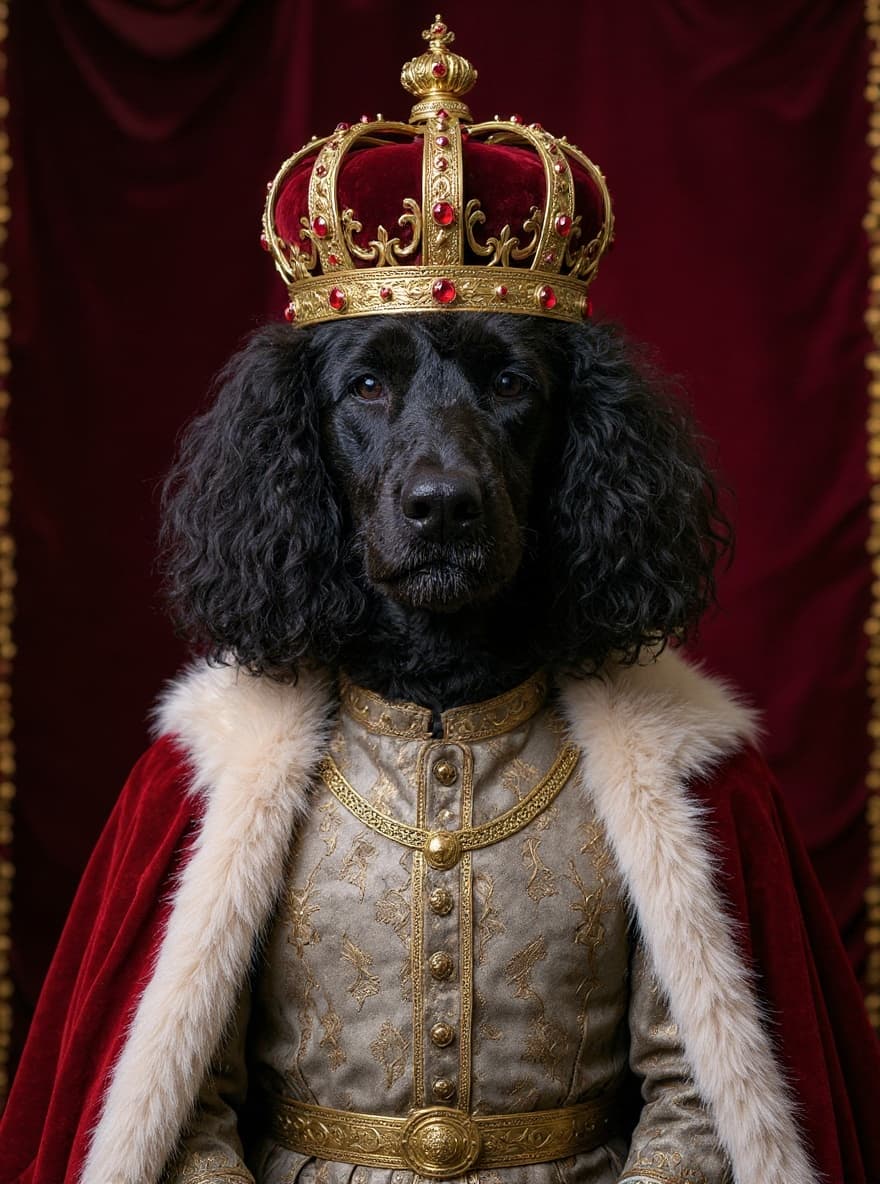
We paint dogs in three studio styles. The Atelier is the seventeenth-century Flemish vocabulary, all dark backgrounds and warm chiaroscuro. The Sovereign is the royal-regalia treatment, coronation costume and velvet and gold trim. The Oil is the most direct of the three, a classical oil painting of the dog as itself, without period costume.
The most common question we get from people commissioning a custom dog portrait is: which one is right for my dog?
The honest answer is that for most dogs, all three styles work. The painter can produce a serious painting in any of the three studio styles for nearly any breed. The choice is less about what is possible and more about what suits the room the painting is going to hang in, and what suits the particular dog's character.
This is the decision tree we walk customers through when they cannot decide.
Start with the room, not the dog
Most decisions about painted portraits should start with where the painting will hang. The room sets the tone the painting needs to match. A modern minimalist living room does not want the same painting as a panelled study or a country cottage hallway.
Three quick questions about the room.
1. Is the room mostly modern or mostly traditional? If the furniture is contemporary, the colour palette is restrained, the walls are off-white or grey, you are in a modern room. The Oil is usually the right choice for a modern room. Its classical-but-direct register reads as quietly serious in a way that pairs with modern interiors without competing.
2. Does the room already have dark wood, antiques, books, or panelled walls? If the answer is yes, you have a traditional room. Both The Atelier and The Sovereign suit traditional rooms; the choice between them depends on the dog, which we will come to. The Oil also works in traditional rooms but can sometimes read as understated next to elaborate Victorian furniture.
3. Will the painting hang alone, or alongside other paintings? A painting hanging alone has more room to do whatever it wants. A painting hanging in a gallery wall of other portraits needs to belong with them. If your wall is mostly muted classical work, The Atelier or The Oil. If your wall is more decorative, The Sovereign can work.
That is the room. Now the dog.
The character of the dog
Some dogs carry the Renaissance register naturally. Some dogs carry the royal regalia. Some dogs are just themselves.
The Atelier suits dogs with strong faces and a certain seriousness. Cavalier King Charles Spaniels, Mastiffs, Bulldogs, Italian Greyhounds, Salukis. These are dogs that have, by breed history or by individual personality, a quality of stillness. The seventeenth-century Flemish register rewards that quality. Dogs with a quieter, more contemplative bearing read in The Atelier the way they would have read in a Van Dyck.
For more on which breeds carry The Atelier naturally, see our companion piece on the breeds most suited to renaissance portraits.
The Sovereign suits dogs with strong characters and owners who want the painting to do some performing. Standard Poodles, Pomeranians with theatrical fur, Pugs who carry themselves with mock seriousness, Whippets who genuinely appear regal. The royal regalia treatment is theatrical by design, and it works best when the dog is in on the joke. The Sovereign is also disproportionately the style customers choose for memorial portraits, perhaps because the formality of the regalia suits the gravity of the occasion.
The breeds we typically steer away from The Sovereign: working dogs whose modern identity is about labour rather than court life (Border Collies, German Shepherds, Australian Cattle Dogs). The royal regalia can read as ironic on a breed whose actual job is to herd sheep.
The Oil suits almost every dog and is our default recommendation when in doubt. The classical oil treatment without period costume is the longest-running register in the painted-portrait tradition and the most forgiving of the three. Labradors, Golden Retrievers, German Shepherds, Rottweilers, the working breeds and the modern American breeds, these almost all sit comfortably in The Oil. So do most mixed-breed dogs, whose individual character is the painted subject rather than any breed-historical register.
If you are stuck between two styles and one of them is The Oil, the answer is usually The Oil. The other two styles are more specialised choices for dogs and rooms where the specific register adds something. The Oil is what you reach for when you want a serious painting of the specific dog you have, full stop.
The colour of the dog
A few quick notes about coat colour that affect the choice.
Dark-coated dogs (black Labradors, Rottweilers, dark-brindle anything) can read as one large shadow in The Atelier's dark-background vocabulary. The painter can compensate, but The Oil's typically lighter ground is more forgiving for dark coats.
Pale-coated dogs (yellow Labradors, Maltese, Bichon Frise, white anything) play beautifully against The Atelier's dark ground and against The Sovereign's gold-and-ermine palette. Both period styles are unusually well-suited to pale coats.
Multi-coloured dogs with strong markings (Cavaliers, Beagles, Australian Shepherds) work in all three styles. The painter renders the markings carefully regardless of register.
A few specific edge cases
Memorial portraits. Customers commissioning a portrait of a dog who has recently passed away ask us about style choice more anxiously than other commissions. Our experience: The Atelier and The Sovereign both work well for memorial portraits because the formality of the period vocabulary suits the occasion. The Oil also works but reads more matter-of-fact, which some customers want and others do not. Pick the style that feels most like a tribute to that specific dog.
Multi-dog portraits. When the commission is of more than one dog (a pair, a family of three), The Oil is almost always the right choice. The classical vocabulary handles composition with multiple subjects more easily than the period styles, which were designed for single-subject portraits.
Puppy portraits. Puppies suit The Oil best. The soft features of a young dog work in the classical register; the period styles can produce paintings that look like the puppy is in costume rather than itself.
Dog-and-human portraits. Not currently in our standard offering, but worth flagging: if you want a painting of yourself with your dog, the period styles introduce challenges (you in coronation regalia is a different decision than a portrait of just your dog in regalia). The Oil is the obvious choice for cross-species compositions.
When you genuinely cannot choose
Order all three. Most customers do not realise they can do this, but you can. Order the digital proof in all three styles, see them side by side, then decide which one to commit to printing. The proof is free and unlimited. The cost of seeing all three is your time, not money.
Most customers, when they see all three side by side, recognise the right answer immediately. The brain knows what it wants when it sees it next to two reasonable alternatives.
That is the decision tree. The room first, the dog second, the coat colour third, and the proof if you still cannot decide.
Sources
- Internal studio notes on style choice, drawn from 18 months of customer commissions
- Companion pieces: breeds most suited to renaissance portraits, Crown & Paw review, West & Willow review